

Published
Call 911 now for chest pain or pressure, new shortness of breath, or shoulder or arm pain with a cold sweat, nausea or lightheadedness. Sudden weakness or numbness in one arm, a drooping face or trouble speaking can be signs of a stroke. Call 911 even if a stroke sign goes away. [1]
After an injury: Go to an emergency department now if your shoulder looks out of place or your hand suddenly turns cold, pale or blue-gray. A sudden loss of blood flow to an arm is an emergency. Do not try to put the shoulder back in place. If you suddenly cannot move or raise your arm after an injury, seek urgent assessment now at an emergency department rather than trying exercises. If the exam suggests a new tendon tear, ask about prompt orthopedic follow-up. [2] [3] [4]
Possible joint infection: If your shoulder is hot, red or swollen and you have a fever or feel shivery, go to an emergency department now. This also applies if you recently had a shoulder injection. [3] [5]
What changes the repair plan?
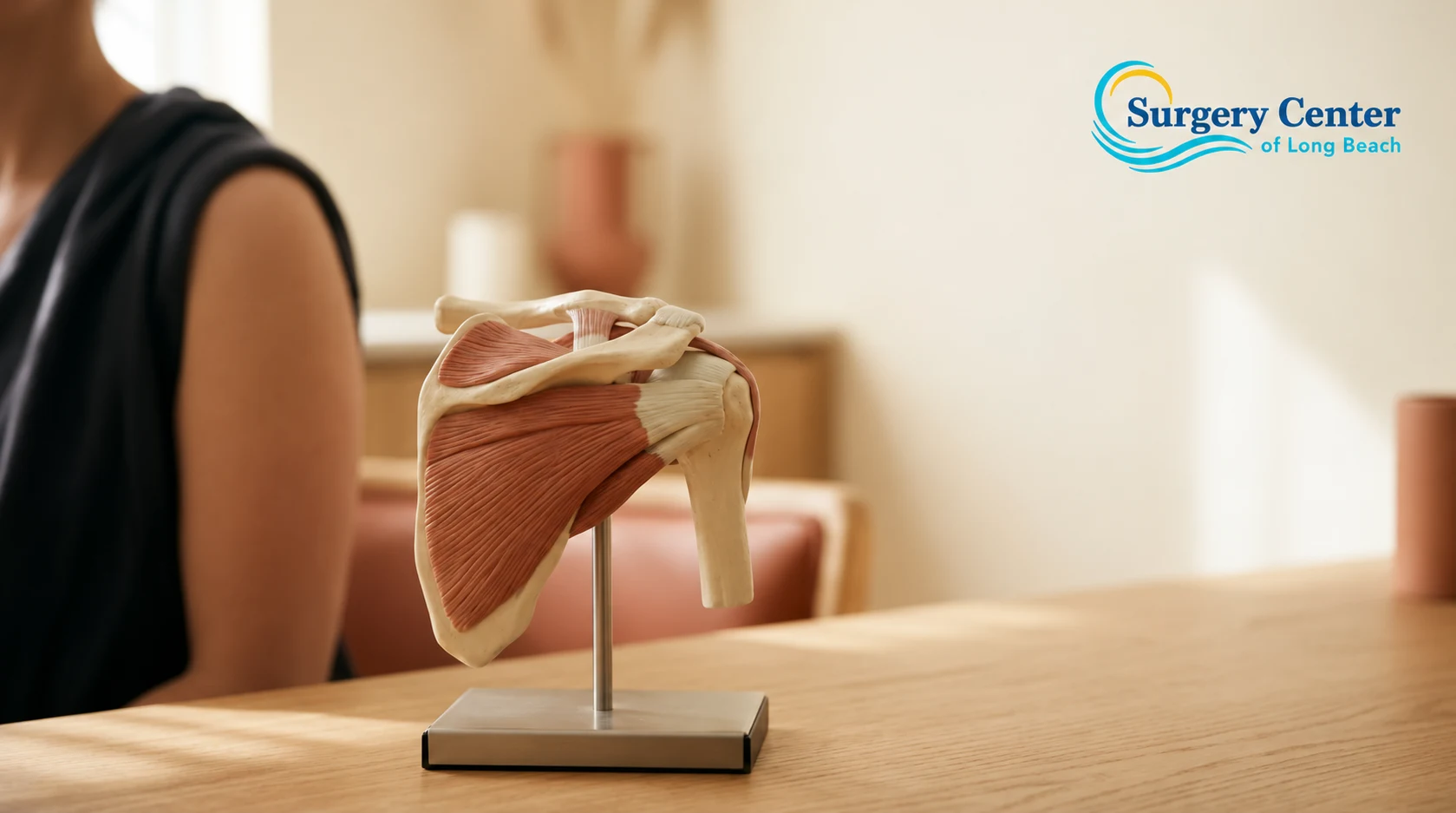
“Full-thickness” tells you how deep a tear goes, not how wide it is. “Large” does not necessarily mean it cannot be repaired. In a rotator cuff repair, the surgeon reattaches torn tendon to the upper arm bone. There are two separate questions: Can the tendon reach the bone and hold stitches? Would repairing it help with something that matters to you, such as sleeping comfortably or lifting a tool? A scan helps with the first question; it cannot answer the second on its own. [6] [7] [8]
Our guide to which tissues are repaired explains the attachment. Here is how to read the words that distinguish one tear from another.
| Tear feature | What it means for your decision |
|---|---|
| Partial-thickness | Some fibers are still attached through the damaged spot. Ask how much of the tendon’s depth is torn. A shallow tear and one that goes more than halfway through are both partial tears. [6] [8] |
| Full-thickness | The tear passes through every layer at that spot. Tendon can still be attached on either side. Ask how wide the gap is. [6] |
| Large or massive | Ask for the tear measurements and the names of the tendons involved. The label describes the extent of the damage; it does not tell you how much can be reattached. [7] [8] |
| Retracted | The torn edge has pulled back from bone. A tear two centimeters wide is not the same as an edge pulled back two centimeters. The surgeon may need to move the tendon during surgery to tell whether it reaches without too much tension. [7] |
| Tendon and muscle quality | Thin, frayed tendon may not hold stitches securely. Atrophy means the attached muscle has lost bulk; fatty change means fat is visible within that muscle. Ask what each finding means for a lasting repair, not just whether stitches can be placed. [6] [7] [8] |
Does the tear explain what you cannot do?
Tell your clinician what changed: “I could reach the shelf before my fall; now I can’t lift my empty hand” is different from “I can still reach, but the ache wakes me at night.” The exam can compare strength and how far you can move the arm yourself with how far it moves with help. X-rays can show a fracture or arthritis, but not the cuff tendons directly. Ultrasound or MRI can show a tear; MRI can also show muscle changes. Some tears cause no pain, so the findings need to fit your symptoms and exam. See our rotator cuff condition guide for more on symptoms. [6] [8]
When is therapy a reasonable first choice?
For adults with symptomatic small-to-medium full-thickness tears, the American Academy of Orthopaedic Surgeons (AAOS) finds that both physical therapy and surgery can improve symptoms and function. Therapy can help you use the arm without reattaching the tendon. With nonsurgical care, some full-thickness tears enlarge, and muscle loss or fatty change can progress over five to ten years. That is a possibility, not a deadline. Agree on a task and a measure of strength to recheck. [8]
The most useful comparison depends on your tear:
- Deep partial tear: A trial of isolated tears more than halfway through the supraspinatus, one of the cuff tendons, compared immediate repair with six months of nonsurgical care before planned repair. Ten people in the delayed group left the study after their symptoms improved during nonsurgical care. Six months was the study plan, not a required wait. [9]
- Small or medium tears: In adults over 55 with a single-tendon tear that developed without an injury and averaged about one centimeter, shoulder scores did not differ significantly at about six years among three groups: therapy, smoothing bone above the tendon plus therapy, or tendon repair plus both. A separate trial included 103 adults with full-thickness tears up to three centimeters. At 15 years, average shoulder scores favored initial open or mini-open repair over therapy with the option of later repair. [10] [11]
- New injury: A trial of 58 people with small traumatic tears found no significant difference in the main shoulder score at one year between early repair and therapy. It does not tell us how long someone with a large new tear and sudden weakness can safely wait. [12]
If surgery is proposed, what is the backup plan?
For a deep partial tear that still limits you after nonsurgical care, ask whether the goal is to trim frayed tissue or reattach tendon. Trimming, called debridement, is not a repair. For a large, retracted tear, a partial repair means reattaching only the portion that can reach bone securely. That is different from repairing a partial-thickness tear. [7] [8]
If a complete repair is not possible, options include continued therapy. Depending on your strength, goals and arthritis, a specialist may discuss trimming damaged tissue, sometimes with a biceps tendon procedure; moving another tendon to help the shoulder work; or using a graft to rebuild the top of the joint capsule. For some people with major loss of function despite other care, including those with arthritis, reverse shoulder replacement is a separate option. Evidence does not establish one best fallback. Discuss what you would agree to before surgery. [8]
Healing, pain relief and strength are different outcomes. AAOS found moderate evidence that people whose repairs healed had better reported outcomes and function, on average, than people treated with therapy alone or those whose repairs did not heal. A tendon can fail to heal or tear again; a later scan alone does not tell you how the arm feels or works. Other risks include stiffness, infection and nerve injury. [7] [8]
Questions for your appointment
Our Preparing for Surgery guide and patient resources can help you plan the visit. Our physician directory lists Christopher Combs, MD, for shoulder care.
Diagnosis and choice
- Can you show me the depth, width and pullback on my scan, and which tendons remain attached?
- On my exam, is pain stopping me from reaching, have I lost strength, or both?
- If I choose therapy, what will we recheck, and what change should bring me back sooner?
- If the tendon will not reach or hold stitches, what would you repair and what would need a separate decision?
- What improvement is realistic for my night pain and for the task I want back?
Before surgery
- What eating and drinking instructions apply to me on surgery day?
- Should I arrange a sling fitting or schedule a therapy visit before the operation?
Medicines and other health conditions
- Who will coordinate my written medication plan with my prescribers, including for blood thinners or diabetes medicines if I take them?
- How might my other conditions, such as sleep apnea or diabetes, change anesthesia, monitoring or pain relief?
Companion and home support
- What should my companion know about the ride home and the help I’ll need afterward?
- How can I dress, bathe and use a cane or walker safely if I rely on this arm?
Recovery and urgent help
- Based on what you actually repair, which movements can I do myself and which need assistance?
- What milestones should I meet before driving, lifting at work or reaching overhead?
- If I have a nerve block, when should feeling and movement return, and what should I do if they do not?
- Which symptoms mean 911 or the emergency department, and which discharge number should we use for an urgent concern at night?
Getting help after surgery
Use the emergency actions above first, including for a newly cold, pale or blue-gray hand. For spreading incision redness, pus, pain not controlled by your prescribed plan, or numbness or weakness lasting beyond what your team told you to expect, contact your surgeon right away using your discharge instructions. If you cannot reach the team promptly for an urgent problem, go to an emergency department. [13]
For a nonemergency concern that cannot wait after hours, on weekends or on holidays, use the answering-service option at your physician’s practice number. After surgery, follow the contact route on your discharge instructions. For routine matters, use the regular office message process.
Learn More
- American Heart Association: Heart Attack and Stroke Symptoms
- AAOS OrthoInfo: Dislocated Shoulder
- Shoulder Pain Diagnosis, Treatment and Referral Guidelines for Primary, Community and Intermediate Care
- Society for Vascular Surgery: Acute Limb Ischemia
- NHS inform: Shoulder problems
- AAOS OrthoInfo: Rotator Cuff Tears
- AAOS OrthoInfo: Rotator Cuff Tears: Surgical Treatment Options
- AAOS: Management of Rotator Cuff Injuries Evidence-Based Clinical Practice Guideline
- When Should We Repair Partial-Thickness Rotator Cuff Tears? Outcome Comparison Between Immediate Surgical Repair Versus Delayed Repair After 6-Month Period of Nonsurgical Treatment
- Operative versus conservative treatment of small, nontraumatic supraspinatus tears in patients older than 55 years: over 5-year follow-up of a randomized controlled trial
- Fifteen-Year Results of a Comparative Analysis of Tendon Repair Versus Physiotherapy for Small-to-Medium-Sized Rotator Cuff Tears
- Surgery and physiotherapy were both successful in the treatment of small, acute, traumatic rotator cuff tears: a prospective randomized trial
- Veterans Health Library: Discharge Instructions for Shoulder Arthroscopy
Sources checked November 25, 2026.