

Published
If you are experiencing a medical emergency, call 911. Call now for chest pain or pressure, new shortness of breath, or shoulder or arm pain with a cold sweat, nausea or lightheadedness. Sudden weakness or numbness in one arm, a drooping face or trouble speaking can be signs of a stroke. Call 911 even if the sign goes away. [1]
After an injury: Go to an emergency department now if your shoulder looks out of place or your hand turns cold, pale or blue-gray. If you suddenly cannot move your arm after an injury, seek urgent medical assessment now. A fracture, dislocation and tendon tear can feel similar. [2] [3] [4]
A rotator cuff tear usually affects a tendon where it attaches to the ball of the upper arm bone. In a typical rotator cuff repair, the surgeon brings the torn tendon back to bone and holds it there with stitches so it has a chance to heal. The surgeon is not usually stitching together the fleshy part of a muscle. Not every tear needs repair: physical therapy can help you use the arm more comfortably even if the tendon remains torn. [5] [6]
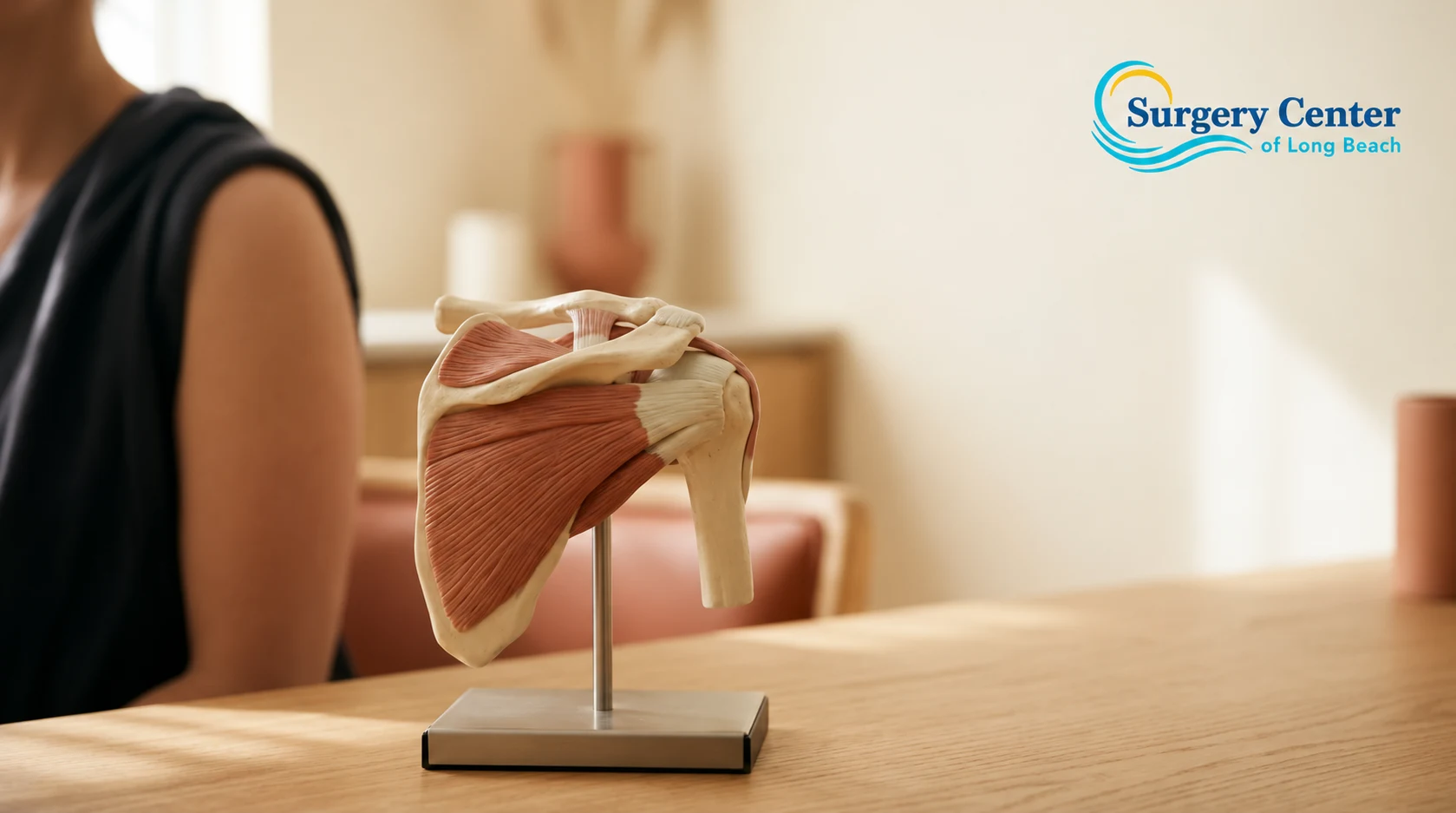
Which tissue is which?
| Tissue | What it means for your shoulder |
|---|---|
| Tendon | Tendons connect muscle to bone. The cuff tendon most often torn is the supraspinatus, near the top of the shoulder. Repair stitches often attach to small anchors placed in the upper arm bone, or humerus. [5] [6] |
| Muscle | Four cuff muscles on the shoulder blade help lift and turn the arm and steady the ball in its socket. Reattaching a tendon gives its muscle a way to pull on the arm bone again. [5] |
| Bursa | This thin, fluid-filled sac helps the cuff glide beneath the bony roof of the shoulder. Trimming inflamed bursal tissue is not the same as closing a tendon tear. [5] [6] |
| Labrum | This firm cartilage rim deepens the socket. A labral repair reattaches the rim to the socket, not a cuff tendon to the ball. [7] |
| Bone | The acromion forms the roof above the cuff. Smoothing its underside is called acromioplasty. The American Academy of Orthopaedic Surgeons (AAOS) does not suggest routinely adding it to arthroscopic repair of small or medium full-thickness tears. [5] [8] |
What do the exam and scan tell me?
Thickness means depth, not width. A partial-thickness tear goes partway through a tendon. A bursal-sided tear is in the tendon on the side facing the bursa. A full-thickness tear goes through every layer at the torn spot; the tendon may still be attached on either side. Retraction describes how far the torn edge has pulled back from bone. [5] [6]
Pain when reaching overhead, trouble sleeping on that side and weakness when lifting or turning the arm can point to a cuff problem. Your clinician checks motion and strength together; several exam findings are more useful than one test alone. An X-ray can show a fracture or arthritis but does not show the cuff tendons directly. Ultrasound or MRI can show a tear. Some cuff tears cause no pain, so a scan alone cannot tell you whether the tear explains your symptoms. [5] [8]
When might therapy, an injection or repair help?
For a gradual-onset tear, physical therapy can improve movement and strengthen the muscles that support the shoulder. Pick a task that matters to you, such as putting a plate on a shelf, and agree on when to reassess it. Get checked sooner if strength declines. Pain relief does not prove the tear has closed; some unrepaired tears enlarge over the years. [5] [8]
AAOS supports considering one steroid injection for short-term improvement in pain and function. It does not reattach the tendon. AAOS advises against repeated steroid injections for cuff tears because they may weaken the tendon and affect a later repair. Tell your surgeon when you last had an injection. In a small study of people with type 2 diabetes who did not use insulin, blood sugar rose temporarily after a shoulder steroid injection. If you have diabetes, ask what to monitor. [8] [9]
If you cannot tolerate steroids, an injectable nonsteroidal anti-inflammatory medicine may be an option. AAOS does not recommend routine platelet-rich plasma (PRP) injections for partial tears or for full-thickness tears treated without surgery. It also advises against prolotherapy, an irritant injection, for full-thickness tears. [8]
Discuss repair sooner if a new injury leaves you markedly weak. Surgery may also be worth discussing if pain or weakness still limits daily life after therapy, including with a deep partial tear. Size is only part of the decision: a tendon that has pulled far back or is too thin to hold stitches can be harder to repair. The condition of the muscle, your age and the strength you need for work or daily tasks matter. Age alone does not decide. [5] [6] [8]
Two trials help put that choice in perspective:
- In a Finnish trial of adults over 55 with small, nontraumatic tears of one tendon, everyone had physical therapy. After more than five years, adding bone smoothing, with or without repair, did not produce significantly greater improvement in pain or shoulder function. [10]
- In a Norwegian trial of 103 adults with full-thickness tears no larger than 3 centimeters, those assigned to initial open or mini-open repair had better shoulder scores at 15 years than those assigned to therapy first. Fifteen of the 51 therapy-first patients later had surgery and were counted in their original group. [11]
The trials studied different groups for different lengths of time. Neither tells you what to do about a large tear after a new injury. [10] [11]
If surgery is proposed, what will actually be done?
Arthroscopy means using a camera through small incisions. It describes how the surgeon reaches the shoulder, not what gets repaired. Debridement means trimming damaged tissue rather than reattaching it. If the whole tendon cannot reach bone, options include continued therapy or repairing the part that reaches. For a massive tear with major loss of function despite other treatment, especially with arthritis, a reverse shoulder replacement may be discussed. That replaces joint surfaces rather than repairing the cuff; guidance for this choice rests mainly on expert agreement. [6] [8]
A repair may not heal or may tear again. Other risks include stiffness, persistent pain, infection and nerve injury. Rehabilitation usually progresses from supported movement to moving the arm yourself, then to strengthening. After arthroscopic repair of small or medium full-thickness tears, studies found similar outcomes with earlier or later movement. Follow the plan for what was actually repaired; less pain is not clearance to lift. [6] [8]
Getting help before and after surgery
After surgery, call 911 for chest pain or pressure, new shortness of breath or stroke signs. Do not wait for a callback. Go to an emergency department now if your hand or fingers turn cold, pale or blue-gray. [1] [3]
Use your surgeon’s daytime or after-hours contact on your discharge instructions right away for fever or chills, spreading redness or pus, bleeding that soaks the dressing, pain your prescribed plan does not control, or numbness or weakness that starts or persists after a nerve block should have worn off. If you cannot reach the team promptly for one of these symptoms, go to the nearest emergency department. [12]
Before surgery, for a nonemergency concern that cannot wait until the office reopens, use the answering-service option at the practice number you have confirmed with your physician’s office. This applies after hours, on weekends and on holidays. For routine matters, use the regular office message process.
This information is for educational purposes only and is not a substitute for professional medical advice, diagnosis or treatment. Talk with your physician about your individual care.
Questions to take to your appointment
Use our physician directory, surgery preparation guide and patient resources as you plan with your companion.
Diagnosis and choice 1. Can you show me which tendon is torn and how that finding matches my weakness? 2. What change in my strength or daily activities would make you recommend repair rather than more therapy? 3. If the tendon will not reach bone or hold stitches, what would you do instead? 4. Would a tissue patch offer a benefit in my case, and which risks matter most for me?
Before surgery 5. What anesthesia do you recommend, and what is my pain plan as a nerve block wears off? 6. When should I stop eating and drinking for my scheduled procedure?
Medicines and health conditions 7. Can I have written take, pause and restart instructions for my medicines, including blood thinners, diabetes or weight-loss medicines, and supplements? 8. How should I manage my blood sugar while fasting, and how might sleep apnea or past anesthesia problems change my plan?
Companion and home support 9. Who should drive me home, and how long should someone stay with me? 10. How can I dress, use my walker or get out of a chair without pushing through the healing arm?
Recovery 11. When may I remove the sling for washing, sleep or exercises? 12. When should therapy start, and which movements or loads must I avoid? 13. What do I need to be able to do safely before driving or returning to my work tasks?
Urgent help 14. If I have a block, how long should arm numbness or weakness last? 15. Before we leave, can you show my companion the daytime and after-hours contacts and the symptoms that mean we should go straight to emergency care?
Learn More
- American Heart Association: Heart Attack and Stroke Symptoms
- AAOS OrthoInfo: Dislocated Shoulder
- Society for Vascular Surgery: Acute Limb Ischemia
- NHS: Shoulder pain
- AAOS OrthoInfo: Rotator Cuff Tears
- AAOS OrthoInfo: Rotator Cuff Tears: Surgical Treatment Options
- AAOS OrthoInfo: Shoulder Joint Tear (Glenoid Labrum Tear)
- AAOS: Management of Rotator Cuff Injuries Evidence-Based Clinical Practice Guideline (2025)
- Safran et al.: The effect of steroid injection into the shoulder on glycemia in patients with type 2 diabetes
- Kukkonen et al.: Operative versus conservative treatment of small, nontraumatic supraspinatus tears in patients older than 55 years: over 5-year follow-up of a randomized controlled trial
- Moosmayer et al.: Fifteen-Year Results of a Comparative Analysis of Tendon Repair Versus Physiotherapy for Small-to-Medium-Sized Rotator Cuff Tears
- Veterans Health Library: Discharge Instructions for Shoulder Arthroscopy
Sources checked November 24, 2026.