

Published
Heel or leg symptoms that need help now
- Call 911 for sudden trouble breathing, chest pain, coughing up blood or fainting. These can be signs of a blood clot in the lung. Lightheadedness or a racing or irregular heartbeat can also occur. [1]
- Call 911 if your foot or toes suddenly turn cold and pale, gray or blue. This can mean loss of blood flow, especially with sudden severe pain, new numbness or weakness. Don’t wait for a nerve block to wear off. Don’t drive yourself. [2]
- After surgery, call your operating team now, day or night, if your dressing or splint feels tight and the pain keeps getting worse. Use the number in your discharge instructions. If you can’t reach the team promptly, have someone take you to an emergency department. For sudden, severe pain, get emergency care without waiting for a callback. Adjust the dressing only as your team directs. [3] [4]
- For new pain, swelling, warmth or redness in one calf or leg after surgery, call your discharge contact right away. You need to be assessed the same day. If the team can’t arrange that, go to an emergency department. [1]
- Before surgery, get medical care right away for severe heel pain just after an injury, severe pain with swelling, heel pain with fever and numbness or tingling, or new trouble pointing your foot down, rising on your toes or walking normally. Don’t wait for a routine surgical visit. [5]
When is release worth discussing?
A surgeon may discuss plantar fasciotomy, also called plantar fascia release, when pain under the heel still limits walking, standing or work despite months of appropriate nonsurgical care and a fresh examination still points to the plantar fascia as the source. Most people with plantar fasciitis improve without surgery. The American Academy of Orthopaedic Surgeons generally reserves surgery for people who have not improved after 12 months of active nonsurgical treatment. That is guidance, not a deadline. A heel spur on an X-ray is not, by itself, a reason to operate. [6]
Bring one example of what you still can’t do. If you can now walk the dog but can’t finish a shift on your feet, that gives you and the surgeon a specific goal against which to weigh further treatment.
What should be checked or tried first?
Pain with the first steps after rest and tenderness near the inner underside of the heel fit a plantar fascia problem. A heel-bone stress fracture, trapped nerve or problem at the back of the heel may need different treatment. MRI or ultrasound is not routine for typical plantar fasciitis. If a test is proposed, ask what else the surgeon suspects and how the result would change the plan. [6] [7]
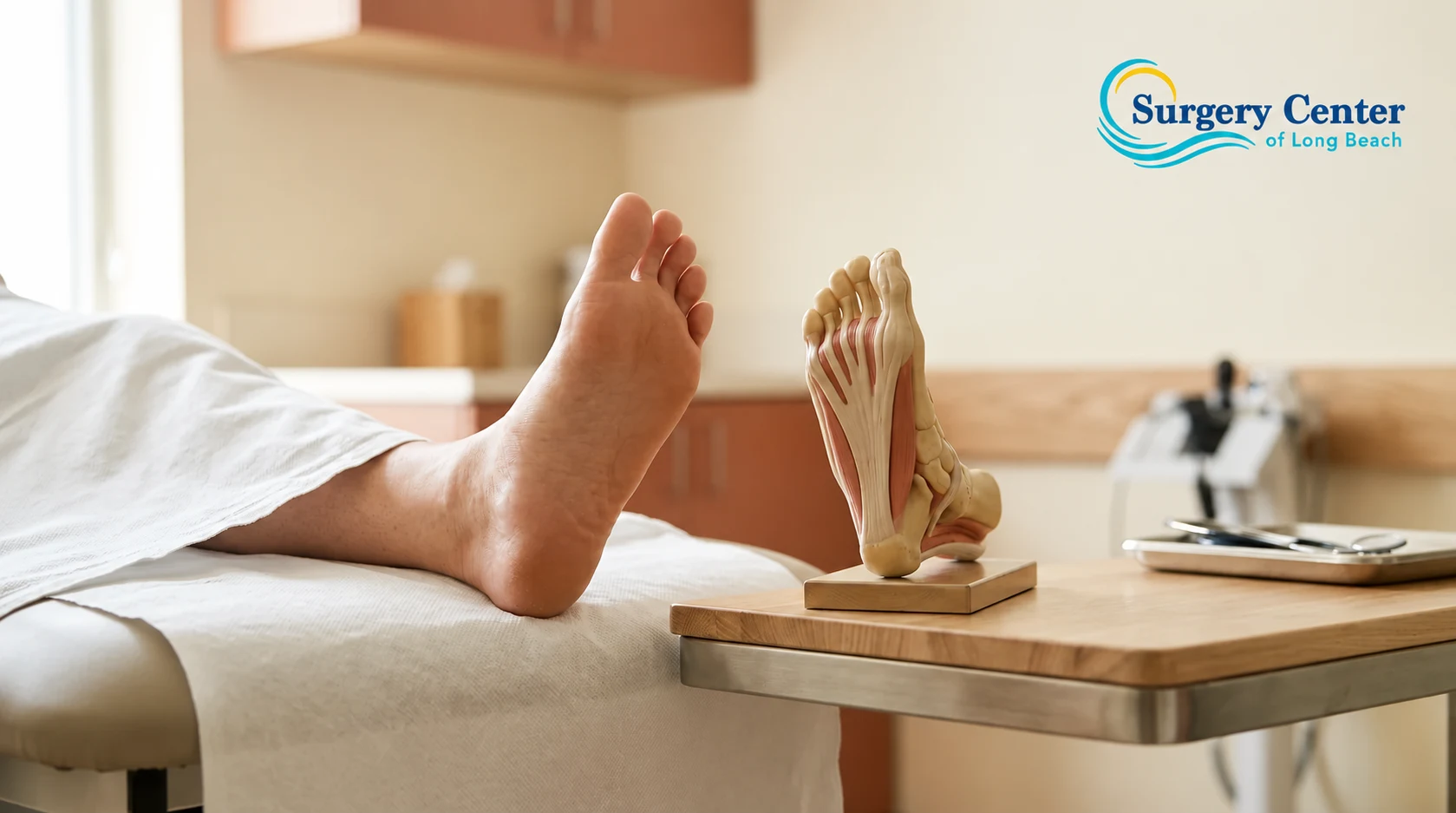
Review what you tried, for how long and what got in the way. Adjusting time on your feet, calf and foot stretches, physical therapy, supportive shoes or inserts may still be useful. A night splint is worth discussing if the first steps each morning remain the hardest. The companion guide, Plantar fasciitis: diagnosis and nonsurgical care, focuses on these choices. [6] [7]
Shockwave therapy for heel pain uses pressure pulses without an incision. A cortisone injection is another option, but it can weaken the fascia and lead to rupture—an unintended tear. Tell the surgeon about previous injections before deciding on another. [6]
What does the operation release?
The plantar fascia is a strong band along the sole, from the heel toward the toes, that helps support the arch. In a partial release, the surgeon cuts part of the band near the heel to ease tension, leaving the rest intact. An open operation lets the surgeon see the fascia through an incision; an endoscopic operation uses a small camera. Spur removal is a separate step and is usually unnecessary. [6]
If a tight calf still limits how far your ankle bends upward despite stretching, the surgeon may discuss gastrocnemius recession instead. This lengthens part of the calf rather than cutting the fascia. Ask which finding on your exam favors one operation over the other. [6]
How much relief can I expect?
| What was compared? | What did patients experience? |
|---|---|
| Release versus shockwave therapy. A trial of 65 people with more than six months of persistent heel pain compared endoscopic release plus tissue clean-up with focused, high-energy shockwave therapy. [8] | The main measure was change in first-step morning pain at three months. On a separate one-year measure, 24 of 31 in the surgery group and 24 of 34 in the shockwave group had a good or excellent result. “Good” allowed occasional discomfort. The difference was not statistically clear; the trial did not prove the treatments equivalent. [8] |
| Surgery plus strengthening versus injections plus strengthening. A trial of 30 adults with more than three months of symptoms combined partial release, tissue clean-up and spur removal. The comparison group received cortisone injections and the same strengthening program. [9] | Foot-function scores favored the surgery group at one year; the difference was not statistically clear at two years. Pain during activity favored surgery at two years. The study cannot tell us how much benefit came from release alone. [9] |
A systematic review found that the trials were small and compared different treatments. They cannot give you a dependable personal chance of pain-free walking. [10]
Which risks matter for my foot?
Heel pain can persist, and nerve injury can leave numbness. In a prospective study, people who developed pain along the outside of the foot tended to have had more of the fascia released. That finding does not establish a safe amount to release for every foot. [6] [11]
Tell the team about diabetes, reduced feeling in your feet, circulation problems and tobacco use. In a study across foot and ankle operations, nerve damage and poor long-term blood sugar control were linked to wound infection. It was not a study of fasciotomy alone. [12]
Plan for the first night and the return to activity
Before booking, work out how you’ll get from bed to the bathroom. A boot does not, by itself, mean you have permission to walk. Ask how much weight you may put on the foot and practice with any crutches or walker you’ll need. Use our guide to preparing for surgery to plan your ride and home support. Get personal instructions for food, liquids and medicines; don’t change a medicine on your own.
Use our foot and ankle procedure questions to get a written plan for pain relief, dressing care and follow-up. Ask about regular shoes, driving, standing through a shift and returning to sport separately. Being able to cross a room is not the same as being able to brake safely.
After surgery, follow your discharge instructions for whom to call. For a nonemergency concern that cannot wait until the office reopens, use the answering-service option at your physician’s practice number after hours, on weekends or on holidays. For routine matters, use the regular office message process.
Questions to take to your appointment
Diagnosis and choice 1. Which finding points to the fascia rather than a nerve, bone or heel-pad problem? 2. If I continue nonsurgical care, what would we change, and how would we judge progress toward my walking or work goal? 3. How much fascia would you leave intact, and are you proposing any other procedure at the same time?
Preparation 4. What are my food and drink instructions for the anesthesia planned for me? 5. Can I practice using my walking aid on stairs before surgery?
Medicines and other health conditions 6. Who will give me a written plan for my medicines and supplements, including any blood thinner or diabetes medicine? 7. Would my blood sugar, foot sensation, circulation or tobacco use change the timing or wound-care plan?
Companion and home support 8. Who should drive me home, and how long should someone stay with me? 9. What should my companion help me do if there are stairs between my bed and bathroom?
Recovery 10. How much weight may I put on the foot at first, and who clears me to increase it? 11. What must I be able to do before driving, standing through a shift or returning to exercise? 12. If my heel still hurts or the outside of my foot starts hurting, what will you check?
Urgent help 13. If I have a nerve block, where and for how long should I expect numbness? 14. Which wound changes or fever should prompt a call that day? 15. Which discharge number should my companion use at night, and which symptoms mean calling 911 instead?
Learn More
- About Venous Thromboembolism (Blood Clots)
- Acute Limb Ischemia
- Care of Casts and Splints
- Compartment syndrome
- Heel pain: When to see a doctor
- Plantar Fasciitis and Bone Spurs
- Heel Pain – Plantar Fasciitis: Revision 2023
- Resistant plantar fasciopathy: shock wave versus endoscopic plantar fascial release
- Endoscopic fasciotomy for plantar fasciitis provides superior results when compared to a controlled non-operative treatment protocol: a randomized controlled trial
- What is the evidence for efficacy, effectiveness and safety of surgical interventions for plantar fasciopathy? A systematic review
- Lateral column symptomatology following plantar fascial release: a prospective study
- Neuropathy and poorly controlled diabetes increase the rate of surgical site infection after foot and ankle surgery
Sources checked November 25, 2026.