

Published
Call 911 if your foot suddenly becomes cold or pale, especially with severe pain, numbness or trouble moving it. These can be signs of a sudden loss of blood flow. [1]
Get medical care right away if you cannot walk or put weight on your foot; the foot looks deformed; or you have serious pain or swelling, especially after an injury. An open or draining wound also needs immediate care, as do signs of infection such as a change in skin color, warmth, tenderness or a fever over 100°F (37.8°C). If you have diabetes, get care right away for a foot wound that is deep, discolored, swollen, warm or not healing. Do not wait for a routine appointment. [2]
Most people with plantar fasciitis improve without surgery. If months of nonsurgical care still leave you unable to stand through a shift or walk where you need to go, ask for a fresh assessment. Before discussing plantar fasciotomy—an operation that releases part of the band under the foot—the clinician should recheck that the band is the source of pain. The question is which procedure, if any, would help more than adjusting the care you have already tried. You do not need to wait months to have unexplained pain evaluated. [3] [4]
Is the plantar fascia the source of pain?
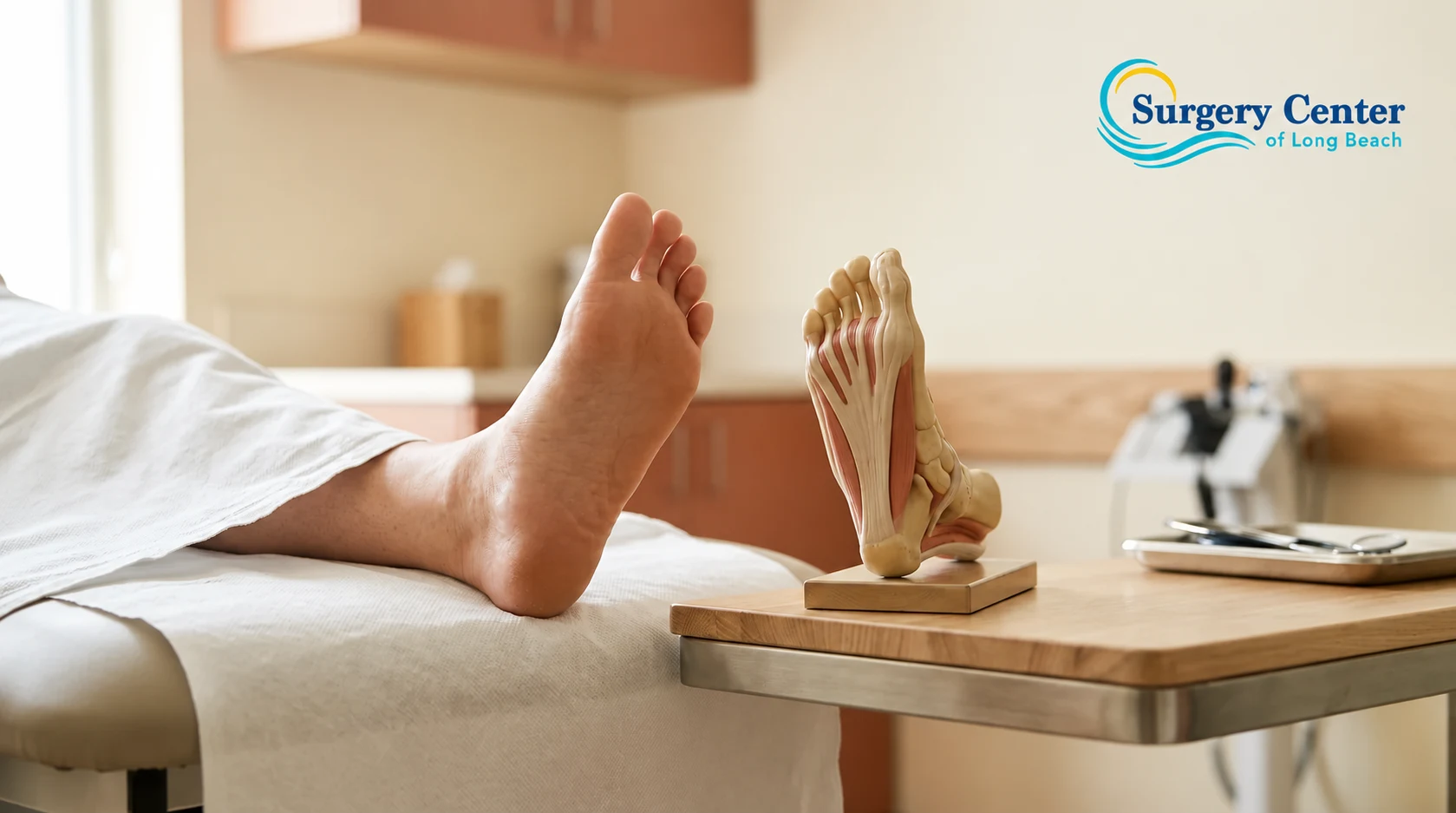
The plantar fascia supports the arch. Pain from this band is often strongest near the inside edge of the heel with the first steps after sleep or a long rest. It may ease as you walk, then return after prolonged standing. That pattern is a clue, not a diagnosis. A clinician checks where you are tender, how far your ankle bends and whether lifting your toes brings on the familiar pain. [3] [5]
MRI and ultrasound are rarely needed to diagnose plantar fasciitis. An X-ray may help identify another cause, such as a fracture or arthritis. A heel spur on an X-ray does not prove it is causing the pain or mean it needs removal. [3]
| What to tell the clinician | Why it matters |
|---|---|
| Pain builds as you walk, especially after a jump in mileage or time on your feet. | A stress fracture in the heel bone is one possibility. Ask whether the foot needs protection before starting exercises. [5] |
| Pain burns, shoots or tingles, or part of the sole feels numb. | A compressed nerve can cause heel pain. Point out where the sensation starts and how far it travels. [5] |
| The center of the heel feels bruised, especially on hard floors. | The heel’s cushioning pad, rather than the fascia, may be sore. [5] |
| Both heels hurt and you have persistent back stiffness or swollen joints. | The combination can prompt an evaluation for inflammatory arthritis. Two sore heels alone do not establish that diagnosis. [5] |
If the cause is unclear, both feet hurt, or you have burning, tingling or numbness without the sudden emergency signs above, see a clinician before trying home treatment, especially if you have diabetes. [2]
Build a nonsurgical plan you can use
Adjust the part of the day that strains the heel. For a standing job, that might mean breaking up one long period on your feet. For a runner, it might mean temporarily replacing hills with lower-impact activity. Choose one useful measure—such as minutes you can stand at work—and track it along with first-step pain. [3] [5]
Learn the stretches and check the fit of your shoes. A seated stretch that gently draws the toes back targets the plantar fascia; a calf stretch targets the back of the lower leg. Ask a physical therapist to watch you try both and decide whether strengthening would help. Bring your work or walking shoes. Taping can offer short-term support. Ready-made or custom inserts can be used alongside other care, but an insert alone is not recommended for short-term relief. Before buying a custom pair, ask what fit problem it would solve. [3] [5]
Match a night splint to the symptom. Physical therapy guidance recommends a one- to three-month trial when the first steps in the morning are consistently painful. A small trial in people with longstanding symptoms found no clear added benefit from a splint over home exercises alone at three months. Agree on when to reassess, particularly if the splint disrupts sleep without making mornings easier. [5] [6]
If pain persists: injections and shockwave therapy
A steroid injection may reduce pain slightly for up to a month compared with a placebo or no injection. A review found no clear lasting benefit. A tear in the fascia or thinning of the heel pad is possible; studies did not record harms well enough to estimate an individual’s risk reliably. Platelet-rich plasma (PRP), prepared from your own blood, is a different injection. Its added benefit is uncertain. [3] [7]
Our shockwave therapy guide describes treatment with pressure pulses through the skin. In a trial of 250 adults with at least six months of heel pain who had already tried several treatments, a combined heel-pain score fell by about 69% after three weekly focused treatments versus 35% after simulated treatment, measured 12 weeks after the last session. Those percentages describe a change in pain, not the chance of a cure. Most researchers had ties to the device maker. Temporary pain and swelling were reported. [8] [9]
In a separate trial of 200 adults, adding radial pressure-wave treatment to advice and custom inserts did not give clearly better relief of pain during activity at six months than advice and inserts alone. The trials did not compare the devices head-to-head. [8] [10]
When does an operation merit discussion?
AAOS recommends considering surgery only after all appropriate nonsurgical treatments have been tried. Foot-and-ankle surgeons’ consensus guidance reserves surgery for persistent symptoms that have not responded to appropriate care. Time spent in pain is not the same as time spent following a workable treatment plan. Bring a record of what you tried, what improved and what you still cannot do. [3] [4]
Release is not the only operation. If a tight calf still limits how far your foot bends up despite stretching, a surgeon may discuss calf lengthening instead. Another procedure, radiofrequency microtenotomy, uses a probe to treat small areas of the fascia. With release, pain can persist and the arch can flatten. Other possible problems include wound trouble, infection and nerve injury. Blood clots are also possible after leg surgery, particularly when movement is limited. [11] Small surgical trials and incomplete reporting of harms make individual benefits and risks hard to predict. [3] [12] [13]
Questions to bring to your appointment
Our foot and ankle procedure questions can also help if an operation is being considered.
Diagnosis and choice 1. Which exam finding points to the fascia rather than the heel bone or a nerve? 2. Would imaging change what I can safely do on the foot now? 3. Given my ankle motion and the care I have tried, why choose release, another procedure or continued nonsurgical care?
Preparation 4. Can you watch me stretch and check the insert in the shoes I wear most? 5. If we plan a procedure, what tests and written eating and drinking instructions will I need?
Medicines and health conditions 6. Which pain medicines are safe with my prescriptions and health conditions? 7. How would diabetes, poor circulation or loss of feeling affect my foot care? 8. Who will give me an individual plan for my medicines, including any blood thinner or diabetes medicine, before and after a procedure?
Companion and home support 9. Who should drive me home and stay with me afterward? 10. Given the stairs at home, what equipment or hands-on help would I need?
Recovery 11. When will we compare morning pain and the time I can comfortably walk or stand? 12. If I have surgery, what findings will guide weight-bearing, driving and returning to work?
Urgent help 13. Which changes in foot color, feeling or wound appearance need immediate care? 14. Which contact on my discharge sheet should I use for a nonemergency concern when the office is closed?
For an evaluation, contact your treating clinician or a foot-and-ankle specialist. We’re an outpatient surgery center, not an emergency department. If you have a procedure scheduled with us, see For Patients for visit preparation and Insurance and Billing for cost questions.
After a procedure, follow the contact instructions on your discharge paperwork. For a nonemergency concern when the office is closed, use the answering-service option at your physician’s practice number.
Learn More
- Acute Limb Ischemia
- Foot pain: When to see a doctor
- Plantar Fasciitis and Bone Spurs
- American College of Foot and Ankle Surgeons Clinical Consensus Statement: Diagnosis and Treatment of Adult Acquired Infracalcaneal Heel Pain
- Heel Pain–Plantar Fasciitis: Revision 2023
- The addition of a tension night splint to a structured home rehabilitation programme in patients with chronic plantar fasciitis
- Steroid injections for painful soles of heels in adults
- Clinically relevant effectiveness of focused extracorporeal shock wave therapy in the treatment of chronic plantar fasciitis: a randomized, controlled multicenter study
- American Family Physician: Focused shockwave therapy trial for chronic plantar fasciitis
- Radial extracorporeal shock wave therapy, sham treatment or exercise added to advice and customised foot orthoses for plantar fasciopathy: randomised trial
- Centers for Disease Control and Prevention: Risk Factors for Blood Clots
- Plantar Fasciitis Surgery
- What is the evidence for efficacy, effectiveness and safety of surgical interventions for plantar fasciopathy? A systematic review
Sources checked November 25, 2026.