

Published
If you or someone with you has sudden signs of a stroke, call 911 immediately. After a wrist injury with numb or pale fingers, severe pain, or visible deformity, go to an emergency department now. See the warning signs below. [1] [2] [3]
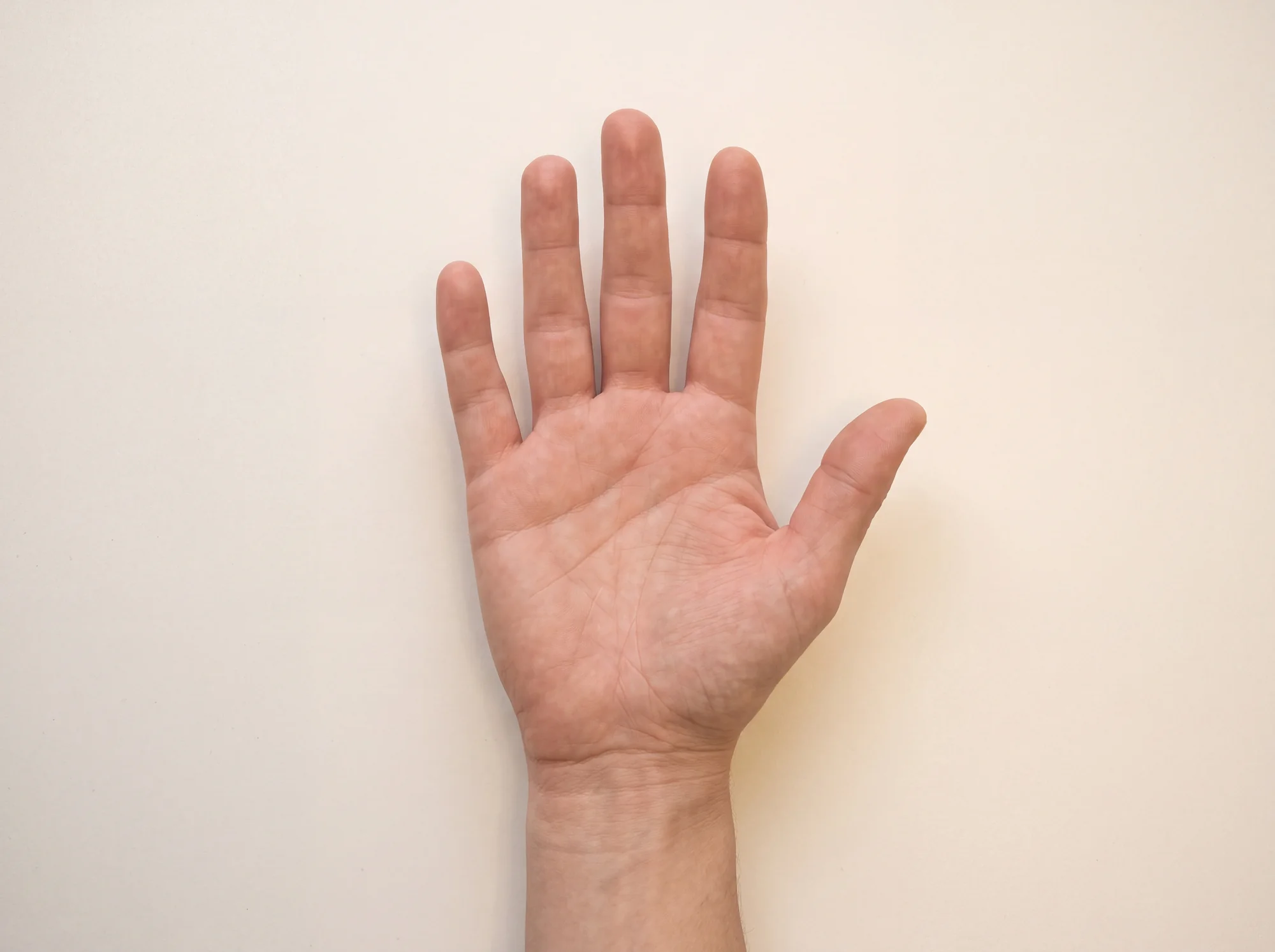
- 1Thumb: tell your clinician whether its tip tingles or its movement feels weak.
- 2Index finger: often involved in a median-nerve symptom pattern.
- 3Middle finger: often involved in a median-nerve symptom pattern.
- 4Ring finger: describe which side, if any, feels different.
- 5Little finger: usually spared in a typical carpal tunnel pattern.
Tingling that wakes you at night and mainly affects the thumb, index finger, middle finger and thumb-side half of the ring finger suggests pressure on the median nerve at the wrist. The little finger usually feels normal. Three details matter at your visit: which fingers are affected, whether feeling returns between episodes, and whether your thumb is getting weaker. A clinician can often diagnose carpal tunnel syndrome from that history and an exam. A nerve test is most useful when its result would change the diagnosis or the next step. [4][5]
When to get help
- Possible stroke: Call 911 immediately for an ambulance if you or someone with you suddenly has any of these signs: numbness or weakness of the face, arm or leg, especially on one side; confusion or trouble speaking or understanding speech; trouble seeing; trouble walking, dizziness or loss of balance or coordination; or a severe headache with no known cause. Note when symptoms first appeared. Call even if they go away. Do not drive yourself or have someone else drive you; treatment can begin in the ambulance. [1] [3]
- After a wrist injury: Go to an emergency department now if the wrist or fingers are numb, the fingers look pale, or the wrist is very painful or visibly deformed. Don’t assume numb fingers after a fall are your usual carpal tunnel symptoms. [2]
- For recurring hand symptoms: Make an appointment if tingling regularly interrupts sleep or hand use. Ask for a prompt assessment if numbness no longer clears, your thumb is losing strength, or the muscle at its base looks smaller. Report those changes rather than waiting to finish a trial of a splint. [4][6]
For a nonemergency change that cannot wait until the office reopens, follow the after-hours instructions from your treating physician’s practice. After surgery, use the contact information in your surgeon’s discharge instructions.
Why does it happen at night?
The carpal tunnel is a narrow passage on the palm side of the wrist. The median nerve shares it with the tendons that bend your fingers and thumb. Sleeping with the wrist curled can increase pressure on the nerve. You might wake with buzzing fingertips, shake your hand and have normal feeling again by morning. Holding a phone or steering wheel can bring on similar symptoms. What brings on an episode does not necessarily explain why the nerve became compressed. [4][6]
The nerve also powers some of the muscles that move the thumb. If buttons have become difficult, describe what makes them difficult: “I can’t feel the edge of the button” tells the clinician something different from “I can feel it, but I can’t bring my thumb across to grasp it.” Mention pain with pinching, too, rather than using “weakness” to describe all three experiences. [4][6]
Which pattern should you describe?
These are clues about where to examine, not a way to diagnose yourself. If your whole hand feels asleep, say so; you don’t need to make your symptoms match a diagram. [4][7][8]
| What you notice | What the clinician may check |
|---|---|
| The thumb, index and middle fingers tingle at night; the little finger feels normal. | Feeling in those fingertips and strength at the base of the thumb. Together, they help assess the median nerve at the wrist. [4][6] |
| The little finger and the side of the ring finger next to it are the main trouble spots, especially when you also have elbow symptoms. | A different nerve, the ulnar nerve, which can be compressed at the elbow or wrist. [7] |
| Pain travels from the neck down the arm, or weakness affects several arm or hand movements. | Whether a nerve coming from the neck better explains some of the symptoms. The exam may extend beyond the wrist. [8] |
| Both feet are numb as well as the hands, particularly if the feet were affected first. | A more widespread nerve problem, called peripheral neuropathy. Diabetes can contribute to this and can also increase the likelihood of carpal tunnel syndrome. [4][8] |
Tell the clinician about pregnancy, diabetes, thyroid disease, rheumatoid arthritis or a previous wrist fracture. These details can help explain the pattern, but none establishes the diagnosis. If both hands bother you, note whether the same fingers are affected on each side. [4][6]
What can an exam tell you without a nerve test?
The clinician may compare feeling in your fingertips, check whether you can distinguish two nearby touches, and test your thumb against resistance. Bending the wrist or tapping over the nerve may reproduce the tingling you recognize. No single tap or wrist position settles the diagnosis. [5][6]
The CTS-6 is a clinical assessment that combines six clues, including where you feel numbness, nighttime symptoms and findings from the hand exam. The 2024 American Academy of Orthopaedic Surgeons (AAOS) guideline says clinicians can use the CTS-6 to diagnose carpal tunnel syndrome instead of routinely ordering ultrasound or nerve conduction testing/electromyography. That does not mean electrical tests are never useful. The guideline separately advises that MRI should not be used to diagnose carpal tunnel syndrome. If imaging is proposed, ask what other problem the clinician is looking for. [5]
What would an additional test change?
- A nerve conduction study measures how signals travel. Sensors on the skin record responses to brief electrical pulses. Slowing across the wrist can help locate the compression. Testing other nerves can help distinguish a wrist problem from more widespread nerve damage. The results can also help assess severity. [6][9]
- Needle electromyography (EMG) examines muscle activity. If weakness is hard to explain, a fine needle can record electrical activity in selected muscles. This answers a different question from measuring how fast a nerve signal travels. [6][9]
- Ultrasound shows structure, not signal speed. It can show whether the median nerve is enlarged at the wrist. Like an electrical test, it needs to be interpreted alongside what you feel and what the clinician finds. [5][6]
Electrodiagnostic specialists recommend electrical testing more broadly than AAOS does. A useful way to discuss that difference is to ask: “Are we trying to locate the problem, measure nerve damage or look for another cause? What would we do differently with the result?” That question is especially helpful when the finger pattern is mixed or strength is changing. A test result alone is not a decision for or against surgery. [5][9]
How the findings guide treatment
When symptoms come and go and strength is intact, a night splint that keeps the wrist close to straight is one option for mild to moderate symptoms. Agree on what improvement would look like: fewer awakenings, for example, or feeling that returns more fully in the morning. Also agree on when to reassess and what change should bring you back sooner. [6][10]
If short-term relief is a priority, a corticosteroid injection at the wrist is another option to discuss. In trials involving mainly mild to moderate carpal tunnel syndrome, injection probably improved symptoms and hand function compared with placebo or no injection over the first three months. Some symptom benefit was evident up to six months. These trials usually excluded people with diabetes or arthritis, so ask how your health history changes the choice. AAOS finds that injection does not provide long-term improvement. In a separate trial comparing starting with an injection against starting with a night splint, pain and hand function did not clearly differ at two years. People could have additional treatment during follow-up. [5][11][12]
If a shot helps briefly, report exactly what changed and for how long. “My nighttime tingling stopped, but pinching still hurt” is more useful than “the shot worked.” Relief is not proof of the diagnosis or that the nerve has healed. A small study of people with normal electrical tests who later had surgery cannot tell you whether you will improve after release. Lack of relief does not settle that question either. [13]
If numbness has become constant, thumb strength is slipping, or symptoms still disrupt daily life despite nonsurgical care, ask whether it is time for a hand-surgeon assessment. Release surgery divides the ligament over the nerve, not the nerve itself. Longstanding nerve damage may not fully recover. Among adults with confirmed carpal tunnel syndrome who were candidates for either surgery or injection, more met the trial’s symptom-recovery threshold at 18 months when they started with surgery. Some who started with injection later had surgery. That comparison does not mean someone with new, occasional tingling needs an operation. [6][14]
In open release, the surgeon sees the ligament directly through an incision in the palm; mini-open release uses a shorter incision. In endoscopic release, the surgeon views the ligament with a camera through one or two small openings. AAOS found no difference in patient-reported outcomes between mini-open and endoscopic release. That does not promise identical early soreness, risks or time back at work. Ask what each approach would mean for the tasks you need to do. [5][6]
Questions to take to your appointment
- Which of my affected fingers fit median-nerve compression at the wrist, and which do not?
- When I drop things, does my exam suggest loss of feeling, thumb weakness or pain with gripping?
- Should you also examine my elbow, neck or feet?
- Could diabetes, pregnancy, thyroid disease or an old wrist injury change what you check?
- Is my history and exam clear enough to make a diagnosis without another test?
- What decision would a nerve conduction study change?
- Would needle EMG or ultrasound answer a different question in my case?
- If the test result and my symptoms don’t match, what would you check next?
- If I try a night splint, how should it fit, and what improvement should I track?
- What benefit and risks should I expect from an injection given my health history?
- If an injection helps only one symptom, what should I record for follow-up?
- When should we reassess, and which changes should make me call sooner?
- Is there evidence of nerve damage that makes waiting riskier for my hand?
- If you recommend release, which symptoms might improve and which might persist?
- How would mini-open or endoscopic release affect my early use of this hand at home or work?
- If release is proposed, which medicines and health conditions should the surgeon and anesthesia team review before the procedure?
- If I receive anesthesia or sedation, who needs to take me home and help me afterward?
- Which wound, hand-use and follow-up instructions will be specific to my operation, and which changes should make me call urgently?
For more information, see our carpal tunnel condition guide. If you are weighing next steps, our comparison of treatment options, endoscopic release procedure page and questions about the surgical approach cover those decisions in more detail.
Educational notice: This article explains common patterns and choices. It cannot diagnose the cause of your hand symptoms or replace an examination and an individual care plan.
Learn More
- CDC: Signs and Symptoms of Stroke
- AAOS OrthoInfo: Distal Radius Fractures (Broken Wrist)
- American Stroke Association: Stroke Symptoms
- MedlinePlus: Carpal tunnel syndrome
- American Academy of Orthopaedic Surgeons: Management of Carpal Tunnel Syndrome Evidence-Based Clinical Practice Guideline (2024)
- AAOS OrthoInfo: Carpal Tunnel Syndrome
- MedlinePlus: Mononeuropathy
- MedlinePlus: Numbness and tingling
- American Association of Neuromuscular & Electrodiagnostic Medicine: Role of Electrodiagnostic Testing in Carpal Tunnel Syndrome Diagnosis
- Hand Pain and Sensory Deficits: Carpal Tunnel Syndrome, Revision 2026 (JOSPT Clinical Practice Guideline)
- Cochrane: Local Corticosteroid Injection Versus Placebo for Carpal Tunnel Syndrome
- The Effectiveness of Corticosteroid Injection Versus Night Splints for Carpal Tunnel Syndrome: 24-Month Follow-up of a Randomized Trial
- Diagnostic Value of a Carpal Tunnel Corticosteroid Injection in Patients with Negative Electrodiagnostic Studies
- Surgery Versus Corticosteroid Injection for Carpal Tunnel Syndrome (DISTRICTS): A Randomised Trial
Sources checked November 23, 2026.