

Published
A lumbar microdiscectomy is a type of lumbar discectomy. Lumbar tells you where the surgeon will operate: the lower back. Discectomy tells you what the surgeon will remove: disc tissue. Microdiscectomy usually means the surgeon will work through a small opening, using magnification to see the disc and nerve. For a herniated disc, the aim is to take out the tissue pressing on the nerve, not the whole disc. If your referral uses one name and your surgeon uses the other, the plan may be the same. [1] [2]
When to go to the emergency department
With back or leg symptoms, go to an emergency department now if you notice any of the following new changes. This also applies after spine surgery. [3]
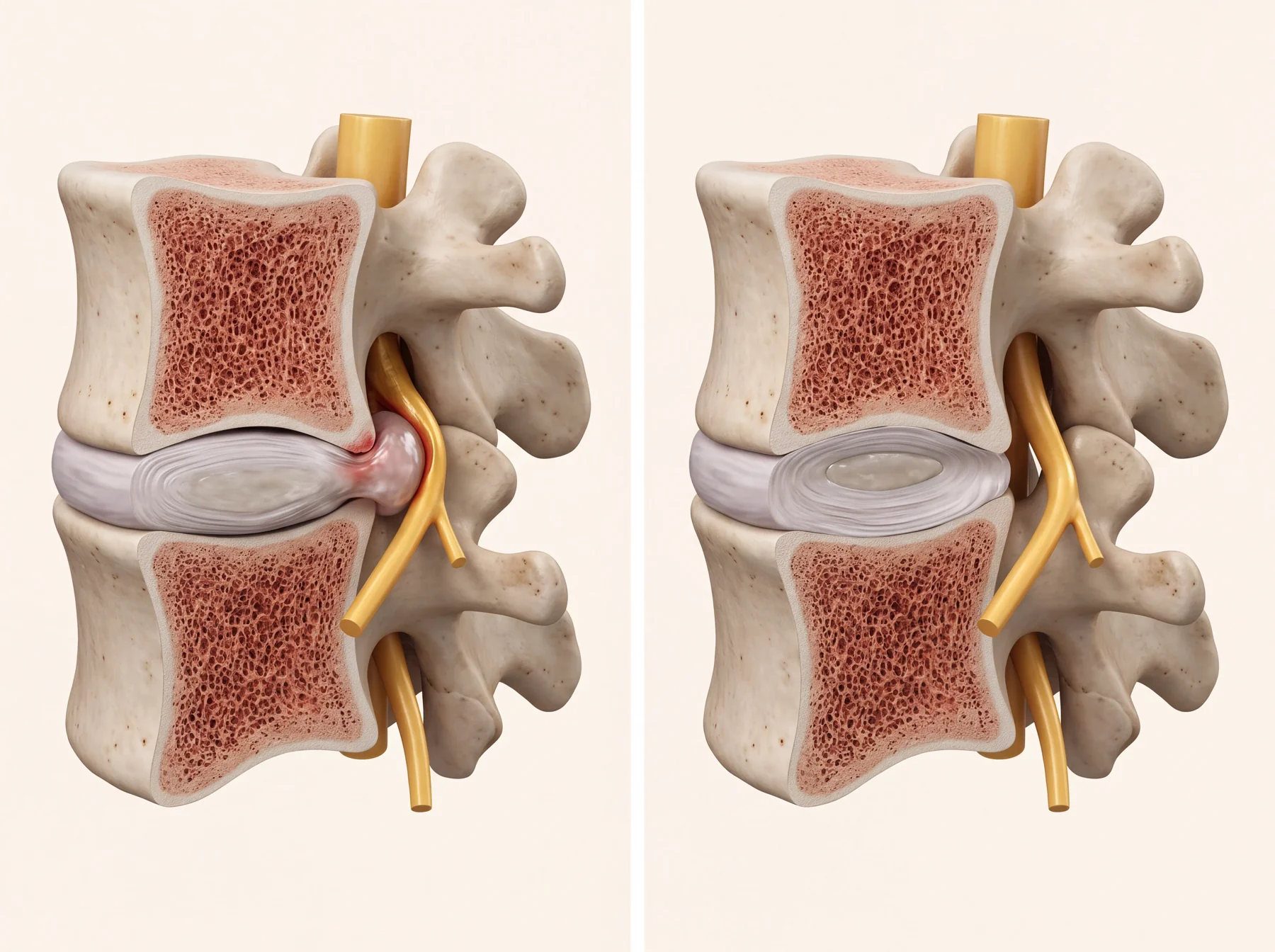
- 1Intervertebral disc between two lower-back bones.
- 2Protruding disc material next to a nerve root.
- 3Nerve root traveling from the spine.
- 4Space beside the nerve after removal of the fragment.
- Bladder: It is hard to start urinating or keep the stream going. You cannot tell when your bladder is full or feel urine passing. You cannot urinate, or you start leaking urine without control.
- Bowels: You no longer feel the need to have a bowel movement, cannot feel it happening, or lose control of stool.
- Feeling between your legs: Your genitals, inner thighs, or the skin around your anus feel numb. Toilet paper may feel different when you wipe. New loss of feeling during sex or a new inability to get an erection can also be warning signs. [3]
These changes can mean that nerves in the lower back are being squeezed, a condition called cauda equina syndrome. Do not wait for an office callback, for complete loss of control, or for a second symptom. New shooting pain down both legs, or pain that spreads from one leg to both, also needs urgent medical advice. If it comes with any of the changes above, go straight to the emergency department. [3]
New leg or foot weakness needs an assessment today. A foot that starts slapping the floor or toes that suddenly catch when you walk are reasons to be examined, even if your bladder feels normal. If you cannot get assessed today, go to the emergency department. Go now if the weakness is severe or getting worse quickly. [3] [4]
How to read your operation plan
Suppose your paperwork says “left L4–L5 laminotomy and microdiscectomy.” That can describe two steps of one operation. Left names the side. L4–L5 is the space between the fourth and fifth bones of the lower back. The lamina is part of the arch of bone behind the nerves. In a laminotomy, the surgeon removes a small piece of that bone to make an opening. The surgeon can then reach the disc fragment and remove it. If another document says diskectomy, the k does not change the meaning. [1] [2]
The word micro is about the way the surgeon works, not how much disc must come out. In one person, a loose fragment may be all that needs removing. In another, the surgeon may also remove material from inside the disc. Ask the surgeon to draw the nerve, the fragment, and the part of the disc that will remain. That sketch can tell you more than the procedure name alone. [1] [5]
Another word you may see is decompression. It describes the goal of taking pressure off a nerve. It does not mean fusion, which joins bones of the spine. The World Federation of Neurosurgical Societies does not recommend routinely adding fusion for a first, isolated herniated disc that causes nerve symptoms. If your plan includes fusion, ask what else the surgeon found. For example, is there evidence that the bones move abnormally at that level? [1] [5]
Does the disc explain the symptom you want to change?
A disc cushions the bones of your spine. If some of its softer center pushes through its tough outer ring, it can press on or irritate a nearby nerve. You may feel that irritation in the buttock, calf, or foot, well away from the disc itself. The pain can feel sharp, hot, or electric. Pain that travels down the leg this way is often called sciatica. The same nerve problem can also affect feeling or strength. [2]
Discectomy is generally better at relieving pain that travels down a leg than an ache that stays in the lower back. Pain, strength, and feeling do not necessarily improve together. For example, you might be able to stand through a shower without shooting pain but still have a numb patch on your foot. Some symptoms may persist. If your main concern is weakness or backache, say so: a prediction about relief of leg pain does not answer your question. [1] [2]
An MRI can show where disc material sits in relation to a nerve. The examination supplies information the picture cannot: where you feel light touch, which movements are weak, and how you walk. If your report names several discs, ask, “Which finding explains what happens in my leg?” Ask the surgeon to show you how the side and level on the scan match your symptoms. A list of changes on an MRI is not, by itself, a list of places that need surgery. [2] [6]
If there is no emergency, what might surgery add?
Many people improve without an operation. A nonsurgical plan can include activity suited to what you can manage, physical therapy or guided exercise, and a discussion about pain relief. For severe sciatica lasting less than three months, UK guidance from the National Institute for Health and Care Excellence (NICE) also says to consider an epidural injection of numbing medicine and steroid. An injection may ease pain for a time; unlike discectomy, it does not take out the fragment. [2] [6]
NICE advises considering decompression when nonsurgical care has not improved pain or function and the scan fits the sciatica. These recommendations date from 2016 and remain in the guideline updated in July 2026. In separate 2026 expert recommendations, AO Spine describes a choice for patients with no loss of strength and sciatica lasting 6 to 12 weeks: surgery for faster relief or continued nonsurgical care. AO Spine instead treats new weakness as time-sensitive and recommends prompt surgical review. [4] [6]
How much faster is relief? A BMJ review compared discectomy with nonsurgical care in people with sciatica from a herniated disc who were candidates for surgery. On a 100-point leg-pain scale, the surgery groups averaged about 12 points less pain in the first six weeks and about 12 points less from six weeks to three months. At one year, the difference was about two points: the groups were similar on average. The estimates are uncertain. Nonsurgical care varied across studies, and some people who started without surgery later had it. [7]
What if it has already been months? A Canadian trial followed 128 adults with pain down one leg for 4 to 12 months and a matching herniation at one of the two lowest disc levels. In its follow-up report, the estimated advantage of starting with surgery was about 2½ points on a 10-point leg-pain scale at six months. By two years it was about 1⅓ points, less than the two points the researchers considered important. At that point, roughly three in ten participants had no follow-up result, and more than a third of those who began with nonsurgical care had chosen surgery. This was a comparison of two ways to start treatment, not surgery versus a commitment never to have it. [8]
If you decide to wait, choose a way to judge progress. Can you now walk through the grocery store, or do you still have to leave before you finish? Are you sleeping longer before leg pain wakes you? Agree on when to review those changes and recheck strength. If your foot starts dragging, an appointment already on the calendar is not a reason to wait. [2] [4] [6]
Open, microscopic, tubular, and endoscopic: what changes?
Some terms describe the path to the disc. Others describe the view of the nerve. That is why more than one term can apply to the same operation. The approaches below explain terms you may hear when discussing surgery with your spine specialist. [1] [9]
| Term | What it means | What to ask |
|---|---|---|
| Open | The surgeon moves tissue aside and works through the exposed opening. Open surgery can be done with or without a microscope. [1] [9] | “What will you use to see the nerve?” |
| Microscopic | An operating microscope gives a lit, enlarged view from outside the opening. The word does not describe the size of the herniation. [1] [9] | “Can you show me the piece you expect to remove?” |
| Tubular | A tube holds a narrow path open through the muscle. Instruments fit down the tube, and the surgeon can use a microscope to look through it. [9] | “Does that path give you a good view of my fragment?” |
| Endoscopic | A small camera goes inside the opening. One route, called transforaminal, approaches from the side through an opening where a nerve leaves the spine. [2] [10] | “Which route do you mean, and why that one?” |
If a surgeon recommends a smaller opening, ask what difference you are likely to notice. Less soreness in your back soon after surgery is a different benefit from less nerve pain in your leg a year later. The position of the fragment also matters. For the side-entry endoscopic route, NICE’s 2016 guidance calls for specific training, work with a mentor, and regular experience doing the procedure. [5] [10]
What happened when researchers compared the approaches?
| Comparison | What patients reported | What the study cannot tell you |
|---|---|---|
| Open surgery without a microscope versus surgery with a microscope | In a trial of 60 adults with an L4–L5 herniation, the microscope group had less back pain at one week and three months. The researchers found no clear difference in leg pain. [11] | Everyone was 29 to 50 years old, and people with muscle weakness were excluded. The study does not tell you which approach best restores strength. [11] |
| Tubular versus conventional microdiscectomy | In a Dutch trial of 325 patients, 74% of respondents after tubular surgery and 77% after conventional surgery felt fully or nearly recovered at five years. The proportions who had another operation were 18% and 13%, respectively. [12] | The difference in repeat operations was not statistically significant. The study did not show a lasting advantage for the tube, or prove the risks identical. [12] |
| Side-entry endoscopic surgery versus open microdiscectomy | A trial at four Dutch hospitals enrolled 613 adults with at least six weeks of pain down the leg. At one year, endoscopy relieved leg pain at least as well. Its advantage was about 7 points out of 100, a difference the authors thought might not be noticeable. [13] | The open surgeons could choose magnifying glasses, a microscope, or neither. The trial excluded some fragments that had moved far from the disc and people with prior surgery at the same or a neighboring level. [13] |
Experience mattered in interpreting the endoscopic trial. Its main comparison set aside 125 operations done while surgeons learned the side-entry technique. In those learning cases, 14 people needed another operation for a repeat herniation within a year. Adding the learning cases back did not substantially change the pain results. A useful question is, “How often do you use this approach for a fragment in this position?” [13]
A 2026 review of 17 randomized trials, with 2,238 patients followed for about 15 months on average, found similar leg-pain relief with fully endoscopic and microscopic surgery. The endoscopic groups had fewer wound problems and returned to work sooner on average, but had more exposure to X-rays during the operation. That is a tradeoff to discuss, not a reason to choose by incision size or a promise about your first day back at work. [14]
What risks should you weigh?
Risks include bleeding, infection, a reaction to anesthesia, injury to a nerve, or a tear in the covering around the nerves that lets spinal fluid leak. Leg pain may remain or return. A recurrence means the disc herniates again. A reoperation means a person has more surgery. Those are different events: not everyone with a new herniation needs another operation. [1] [2] [11]
When you hear a risk estimate, ask what it counts and for how long. In the Canadian trial, 12 of the 80 people who actually had surgery had at least one surgery-related problem during two years of follow-up. That count included problems as different as a wound infection and a nerve injury. In the main Dutch endoscopic comparison, about 5% after endoscopy and 6% after open microdiscectomy had another operation within one year. These figures answer different questions. Neither is a complication rate for this center or a personal forecast. [8] [13]
Preparing for surgery and the trip home
Before the day of surgery, check the proposed side, disc level, and procedure with the team. If you thought the plan was fragment removal but see fusion on a form, ask for an explanation before you sign. Ask what anesthesia is planned, where you will recover, and whether to prepare for a stay. Arrange for someone else to drive you home; feeling comfortable enough to sit in the passenger seat is not the same as being ready to drive. [1] [5] [15]
Bring a list of everything you take, including prescriptions, nonprescription medicines, vitamins, and supplements. Flag blood thinners and medicines you take for diabetes. Ask for one written plan covering what to take, whether anything needs to be paused, when to restart it, and when to stop eating and drinking. If two instructions disagree, have the teams clarify them. Do not make a medication change based on the name of the operation or on someone else’s instructions. [1]
Think through a normal day before you leave for surgery. Who can carry the laundry downstairs, lift a toddler into a car seat, or do the shopping if you cannot? Before discharge, ask for your wound-care and pain instructions, your follow-up plan, and contact information for questions about your own care. If someone is helping you, show them where you will keep those instructions. [1] [15]
Recovery: plan around tasks, not just dates
Ask how to start walking and how to increase the distance. Describe what you need to do at home: climbing a flight of stairs is not the same task as carrying groceries up it. Before driving, ask whether your medicines could impair driving and whether your leg is strong enough to brake hard. For work, describe the commute as well as the job. A desk shift, a delivery route, and a shift spent moving patients place different demands on you. Ask which duties you can resume first and when the others should be reassessed. [2] [15] [16]
There is no single return date to take from a research paper. For example, a trial of 108 people after a first lumbar discectomy compared two weeks of activity limits with six weeks. Through one year, the researchers found no clear difference in pain or ability to do daily tasks. Both groups had limits; the trial did not test immediate heavy lifting. If you have restrictions, ask what each one means for the task you want to do rather than replacing it with a study timetable. [17]
After surgery: which changes need help?
| What you notice | What to do |
|---|---|
| New trouble starting urination or feeling your bladder; loss of bladder or bowel control or sensation; numbness around the genitals or anus; or new loss of sexual sensation | Go to the emergency department now. Do not wait to hear from the office. [3] [16] |
| New leg or foot weakness, including a foot that starts dragging | Get assessed the same day. After spine surgery, go to the emergency department for new or worsening weakness. [4] [16] |
| Clear, watery fluid coming from the incision, or a new headache that is worse sitting or standing and eases when you lie down | Go to the emergency department. These can be signs of a spinal-fluid leak. [16] |
| Fever, chills, increasing redness or drainage at the incision, or pain getting worse despite your pain plan | Contact your surgical team promptly. Tell them what changed, when it started, and, if you measured it, your temperature. [15] [16] |
| New calf pain or swelling in one leg; sudden trouble breathing or new chest pain | Get urgent same-day assessment for the leg symptoms. Call 911 for sudden trouble breathing or new chest pain. A clot in the lung can cause chest or breathing symptoms even without leg swelling. [16] [18] |
Questions to ask your physician
Bring the questions that fit your symptoms and responsibilities. A companion who will help at home can take notes and hear the discharge plan with you.
The diagnosis and choice
- Can you show me which disc and nerve on the scan match my leg pain, numbness, or weakness? What symptoms might remain after surgery?
- Is my strength changing? Which new symptoms should take me to the emergency department, and which should prompt a same-day call before the scheduled visit?
- If I continue nonsurgical care, what would we try, how long would we watch it, and how would we check my strength and function?
- What exactly will you remove or move during the proposed operation? What do “microdiscectomy,” “discectomy,” “tubular,” or “endoscopic” mean in my operative plan?
- What benefits and complications matter most for my anatomy and health, and what could require another operation or a change in the surgical plan?
Preparing for surgery
- Which other health conditions, such as diabetes, sleep apnea, heart or lung disease, or a previous clot, could change anesthesia, monitoring, or whether I can go home the same day?
- Can the surgeon, anesthesia team, and prescribing clinician review all my medicines together, including blood thinners, diabetes medicines, insulin, GLP-1 medicines, opioids, and supplements? Who will give me the final written plan?
- What should I expect from anesthesia, and what should I tell the team about previous nausea, difficult airway care, or reactions to medicines?
- What costs and coverage should I confirm for the surgeon, facility, anesthesia, imaging, therapy, and possible unexpected care?
Discharge and recovery
- Who must drive me home and stay with me? What should that companion know about walking, medicines, wound care, and urgent symptoms?
- Which movements or tasks are restricted for my operation, and who will tell me when to resume driving, work, exercise, lifting, or caring for someone who depends on me?
- What is the plan if leg pain persists, returns, or is replaced by new weakness? When will you recheck me, and would I need imaging or rehabilitation?
- Which symptoms mean call 911, go to an emergency department, or contact your team the same day? What is the after-hours number?
The key distinction is simple: discectomy names the work on the disc; microdiscectomy describes one way to do it. What matters most is whether the fragment explains your symptoms, what you stand to gain by treating it now, and why the proposed route fits your case. [1] [4] [5]
Learn More
- MedlinePlus Medical Encyclopedia. Diskectomy
- American Academy of Orthopaedic Surgeons. Herniated Disk in the Lower Back. OrthoInfo
- NHS England, Getting It Right First Time. National Suspected Cauda Equina Syndrome Pathway. September 2025 version, pp. 5–7
- Vadalà G, Ambrosio L, Chen X, et al. AO Spine clinical practice recommendations: when to operate in lumbar disc herniation. Global Spine Journal. Published September 22, 2026
- Costa F, Oertel J, Zileli M, et al. Role of surgery in primary lumbar disk herniation: WFNS Spine Committee recommendations. World Neurosurgery: X. 2024;22:100276
- National Institute for Health and Care Excellence. Low back pain and sciatica in over 16s: assessment and management. NG59. Updated July 29, 2026; recommendations 1.3.5 and 1.3.8 and definition of acute
- Liu C, Ferreira GE, Abdel Shaheed C, et al. Surgical versus non-surgical treatment for sciatica: systematic review and meta-analysis of randomised controlled trials. BMJ. 2023;381:e070730
- Bailey CS, Glennie A, Rasoulinejad P, et al. Discectomy compared with standardized nonoperative care for chronic sciatica due to a lumbar disc herniation: a secondary analysis of a randomized controlled trial with 2-year follow-up. Journal of Bone and Joint Surgery. 2021;103:2161–2169. Tables III–IV
- American Academy of Orthopaedic Surgeons. Minimally Invasive Spine Surgery. OrthoInfo
- National Institute for Health and Care Excellence. Percutaneous transforaminal endoscopic lumbar discectomy for sciatica. HTG412. Issued April 27, 2016; recommendations and procedure description
- Hamawandi SA, Sulaiman II, Al-Humairi AK. Open fenestration discectomy versus microscopic fenestration discectomy for lumbar disc herniation: a randomized controlled trial. BMC Musculoskeletal Disorders. 2020;21:384
- Overdevest GM, Peul WC, Brand R, et al. Tubular discectomy versus conventional microdiscectomy for the treatment of lumbar disc herniation: long-term results of a randomised controlled trial. Journal of Neurology, Neurosurgery & Psychiatry. 2017;88:1008–1016
- Gadjradj PS, Rubinstein SM, Peul WC, et al. Full endoscopic versus open discectomy for sciatica: randomised controlled non-inferiority trial. BMJ. 2022;376:e065846
- Patel S, Nischal SA, Kale KM, et al. Full endoscopic versus microscopic lumbar discectomy for lumbar disc herniation: a meta-analysis of randomized-controlled trials. Spine. Published online June 18, 2026
- MedlinePlus Medical Encyclopedia. Spine surgery – discharge
- University Hospitals of Leicester NHS Trust. Care after your day case lumbar decompression/discectomy. December 2025; includes the postoperative patient alert guide
- Bono CM, Leonard DA, Cha TD, et al. The effect of short (2-weeks) versus long (6-weeks) post-operative restrictions following lumbar discectomy: a prospective randomized control trial. European Spine Journal. 2017;26:905–912
- Centers for Disease Control and Prevention. About Venous Thromboembolism (Blood Clots). March 5, 2025
Sources checked November 21, 2026.