

Published
A lumbar laminectomy makes room for nerve roots squeezed in the lower back. The surgeon removes bone from the roof of the spinal canal where the nerves are crowded. The main goal is to ease buttock or leg symptoms, such as pain that makes you stop walking. Back pain can improve too, but backache alone is a less reliable reason for this operation. Making more room does not guarantee that lost feeling or strength will return. [1]
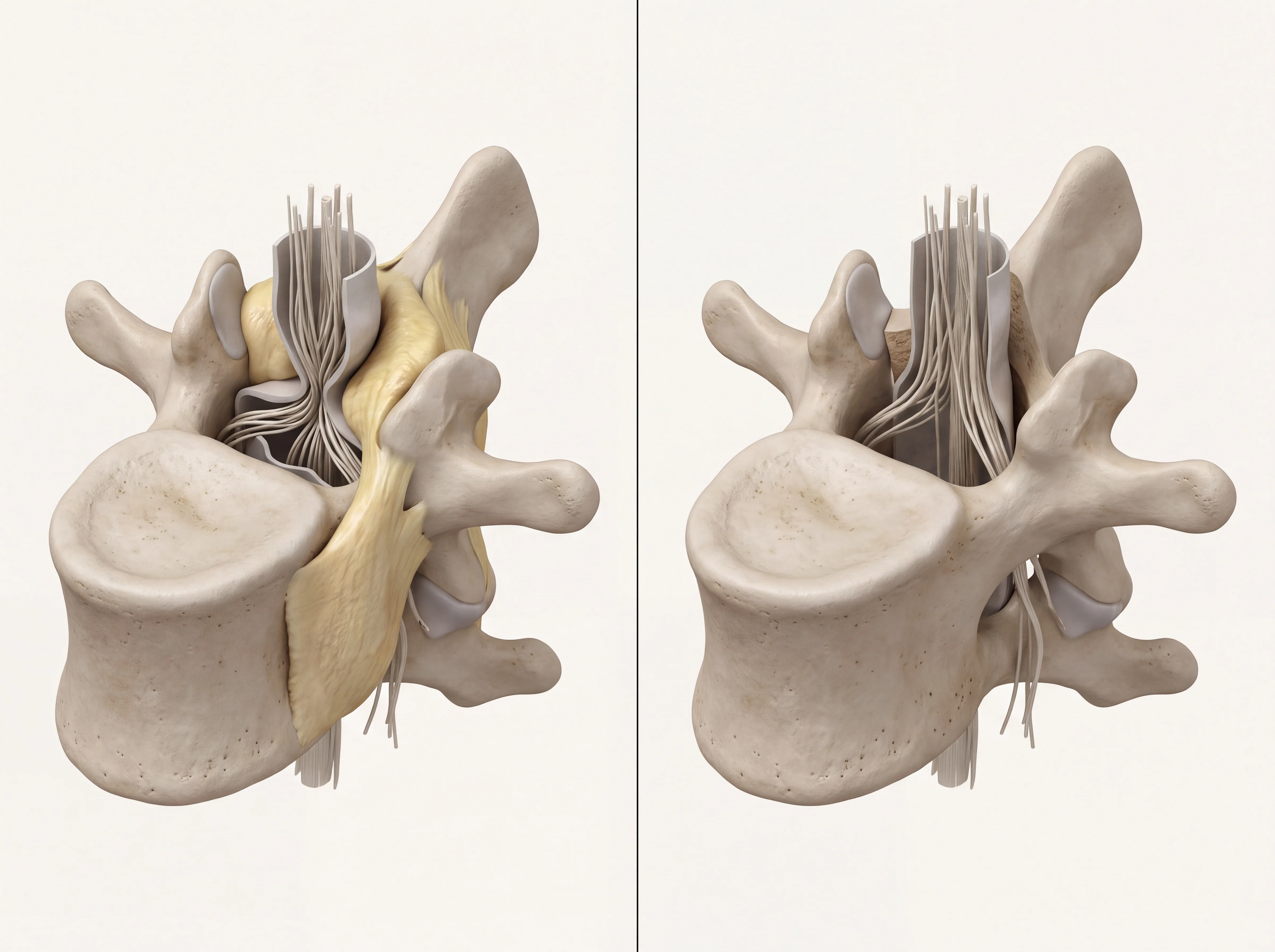
- 1Crowded nerve roots inside the narrowed canal before decompression.
- 2Thickened tissue and bony roof near the crowded nerves.
- 3More space around the nerve roots after decompression; the nerves remain intact.
Before or after surgery: when not to wait
With back or leg symptoms, go to an emergency department now for any of these new changes:
- Trouble starting, feeling or controlling the flow of urine; trouble emptying your bladder; or loss of bladder control.
- Less feeling when you pass stool, not knowing when you need to go, or loss of bowel control.
- Numbness around the genitals, anus or inner thighs, or a new loss of sexual feeling or function.
- New shooting pain down both legs, or leg weakness that is new or getting worse.
These can be signs of serious pressure on the bundle of nerves called the cauda equina. You do not need to have every symptom. Do not wait until you cannot urinate. [2] [3]
Why can a back problem hurt more in the legs?
Lumbar means lower back; cervical means neck. In the lower back, nerves travel through the spinal canal and out through side openings to the legs. Bone spurs, thickened ligaments or disc changes can narrow those passages. That narrowing is called stenosis. [1]
You might walk through a store leaning on a cart, yet have to sit down when you stand in the checkout line. Tell the clinician what makes you stop, how far you get and what brings relief. Sitting or bending forward often helps with stenosis, but that pattern alone does not establish the cause. The clinician checks your strength and feeling and looks for a spot on the scan that matches your symptoms. Narrowing on an MRI is not, by itself, a reason for surgery. [1]
What are my choices?
If symptoms are stable, options include adjusting activities, guided physical therapy, home exercise and a pain-medicine plan suited to your health. Pick a goal you can measure, such as standing long enough to make dinner. If an epidural steroid injection is proposed, ask which symptom it targets. An injection does not remove bone or widen the canal, and rare serious nerve injuries have been reported. [1] [4]
A surgical opinion is reasonable when leg symptoms still limit activities that matter to you and the examination and scan point to the same area. Consider pain relief and walking ability separately:
- In a trial of 169 surgical candidates aged 50 or older, the groups assigned to surgery or physical therapy did not clearly differ in physical function at two years. However, 57% of those assigned to therapy went on to surgery. That does not prove the treatments work equally well. [5]
- In a Finnish trial of 94 people with moderate stenosis, the surgery group had less disability and less leg and back pain at two years than the nonsurgical group. Walking ability did not clearly differ. Some people in the surgery group also had a fusion. [6]
What comes out, and when is fusion a separate choice?
| Procedure | What it changes |
|---|---|
| Laminectomy or laminotomy | The lamina is the bony roof of the canal. A laminectomy removes bone from that roof; a laminotomy makes a smaller opening. The surgeon may also trim thickened ligament or a bone spur. [1] [7] |
| Discectomy | The surgeon removes disc material pressing on a nerve. It can be done with a laminectomy, but the disc can stay in place if it is not the source of pressure. Read more about leg symptoms from a herniated disc. [7] |
| Fusion | Fusion joins neighboring spinal bones for stability. That is a different goal from making room for a nerve. [1] [7] |
A slipped vertebra does not automatically mean you need fusion. In a Norwegian trial of adults with stenosis and a slip of at least 3 mm at one level, decompression alone met the study’s preset standard for being no worse than decompression plus fusion for disability at five years. Repeat lumbar surgery occurred in 16% and 18%, respectively. [8] A smaller U.S. trial in people with a stable slip favored fusion on a general physical-health score at two years, but not clearly on a back-disability score. Over four years, repeat surgery occurred in 34% of the decompression-only group and 14% of the fusion group. These trials studied different groups and operations; ask what problem fusion would solve in your spine. [9]
Risks include bleeding, infection, a blood clot, an anesthesia complication or a tear in the covering around the nerves that leaks spinal fluid. Nerve injury can rarely cause permanent weakness or paralysis. Bone removal can sometimes leave the spine unstable, and a later fusion may be needed. Pain can also persist or return. [1] [7]
Preparing for surgery and the trip home
Lumbar decompression is commonly done under general anesthesia, meaning you are asleep. Tell the team about sleep apnea, heart or lung conditions and past anesthesia problems. Bring a list of medicines and supplements, including aspirin, blood thinners and diabetes medicines. If you have diabetes, get a plan for checking and treating your blood sugar while you are fasting. [7]
If you take semaglutide, tirzepatide or another GLP-1–based medicine, tell the anesthesia team even if you take it for weight loss. These medicines can slow stomach emptying, which matters because stomach contents can enter the lungs during anesthesia. Report a recent dose increase, nausea or vomiting. Ask your anesthesia team and prescriber for a plan specific to you. [10]
Arrange a ride and tell the team if you live alone or have stairs between your bed and bathroom. If you are scheduled at our center, our preparation guide asks you to plan for someone to stay with you for 24 hours after your procedure. Follow the eating, drinking and medicine plan your care team confirms for your own surgery. If general instructions differ from that plan, call before you start fasting or change a dose. If you have not spoken with our staff 24 hours before your scheduled surgery, call our pre-op nurse at (562) 988-9566. [11]
For visit planning, you and your companion can use our patient information hub, patient forms, insurance and billing information, physician directory and directions.
Recovery: what can wait, and what cannot?
Before leaving, have your companion hear the instructions for walking, wound care, pain control and follow-up. Once cleared, start with short walks and build up gradually. Ask about driving, lifting and your actual work duties rather than relying on a fixed date. An area that was numb before surgery may stay numb even if leg pain eases. New weakness or any of the emergency nerve symptoms above is different: go to the emergency department now. [7] [12]
- Call 911 for sudden chest pain or trouble breathing. A new painful, swollen calf needs urgent assessment for a possible clot. [7] [12]
- Call the surgical team right away if clear, watery fluid leaks from the incision, even if you feel well. If the leak comes with a headache or fever, go to the emergency department now. If you cannot reach the team promptly about a leak, seek emergency assessment. [12]
- Call the surgical team right away for fever, increasing wound redness, pus or severe pain that is getting worse. Do not wait for the scheduled wound check. [12]
Questions to take to your appointment
Diagnosis and choice
- Can you show me which nerve is crowded and how that fits what I feel?
- Which is most likely to improve for me: leg pain, time on my feet or strength?
- If I try therapy first, what activity should we track and when should we reassess?
- Would a smaller opening work, and what would justify adding a fusion or using a spacer instead?
Pre-op preparation
- What anesthesia and recovery setting should I plan for?
- What are my specific eating and drinking instructions for surgery day?
Medicines and other health conditions
- Who will give me written instructions for each medicine, including when to restart it?
- If I use insulin, a pump or a glucose monitor, how should I handle fasting and an unusually low or high reading?
- Does a recent GLP-1 dose change or stomach upset change my anesthesia plan?
- How does my sleep apnea or heart or lung condition affect monitoring afterward?
Companion and home support
- What should my companion help with on the ride and the first night home?
- Can someone show us how to manage my stairs safely before I leave?
Recovery and urgent help
- What should I be able to do safely before going home?
- How will we decide when I can drive, lift and return to my usual work?
- Which changes in urination, leg strength or wound drainage mean I should go straight to the emergency department?
- What number should my companion use after hours for an urgent surgical concern?
This information is for educational purposes only and is not a substitute for professional medical advice, diagnosis or treatment. If you are experiencing a medical emergency, call 911.
Learn More
- Lumbar Spinal Stenosis
- Sciatica
- Cauda Equina Syndrome
- FDA-approved methylprednisolone acetate prescribing label (2024), epidural neurologic warning
- Surgery versus nonsurgical treatment of lumbar spinal stenosis: a randomized trial
- Surgical or nonoperative treatment for lumbar spinal stenosis? A randomized controlled trial
- Lumbar decompression surgery
- Decompression alone or with fusion for degenerative lumbar spondylolisthesis (Nordsten-DS): five year follow-up of a randomised, multicentre, non-inferiority trial
- Laminectomy plus Fusion versus Laminectomy Alone for Lumbar Spondylolisthesis
- Multi-society clinical practice guidance for the safe use of glucagon-like peptide-1 receptor agonists in the perioperative period
- How to Prepare for Surgery
- Post-operative recovery following lumbar decompression surgery
Sources checked November 22, 2026.