

Published
When is it reasonable to watch a gradual bend?
Arrange a hand-surgeon visit if your finger is getting harder to straighten or the bend is changing how you use your hand—even if it doesn’t hurt. If a known Dupuytren’s lump or mild bend is stable and your hand still does what you need, observation is reasonable. An evaluation does not commit you to Dupuytren’s surgery. [1]
Pick one task to track. Do you now need your other hand to guide the finger into a glove? Can you still open your hand enough to wash and dry your palm? Resting your hand gently on a table can help you notice change, but you don’t have to fail a tabletop test, reach a particular angle or wait for pain to ask for help. Don’t force the finger flat. [1]
A Dupuytren’s cord is a thickened band of fascia, the tissue beneath the palm skin. It is not the tendon that bends your finger. A finger that clicks or locks during movement may instead be trigger finger, in which the tendon catches. Have a new, growing or painful palm lump examined rather than assuming it is Dupuytren’s. A lump alone does not mean you need treatment, and stretching or splinting an untreated finger does not reliably prevent worsening. [1] [2]
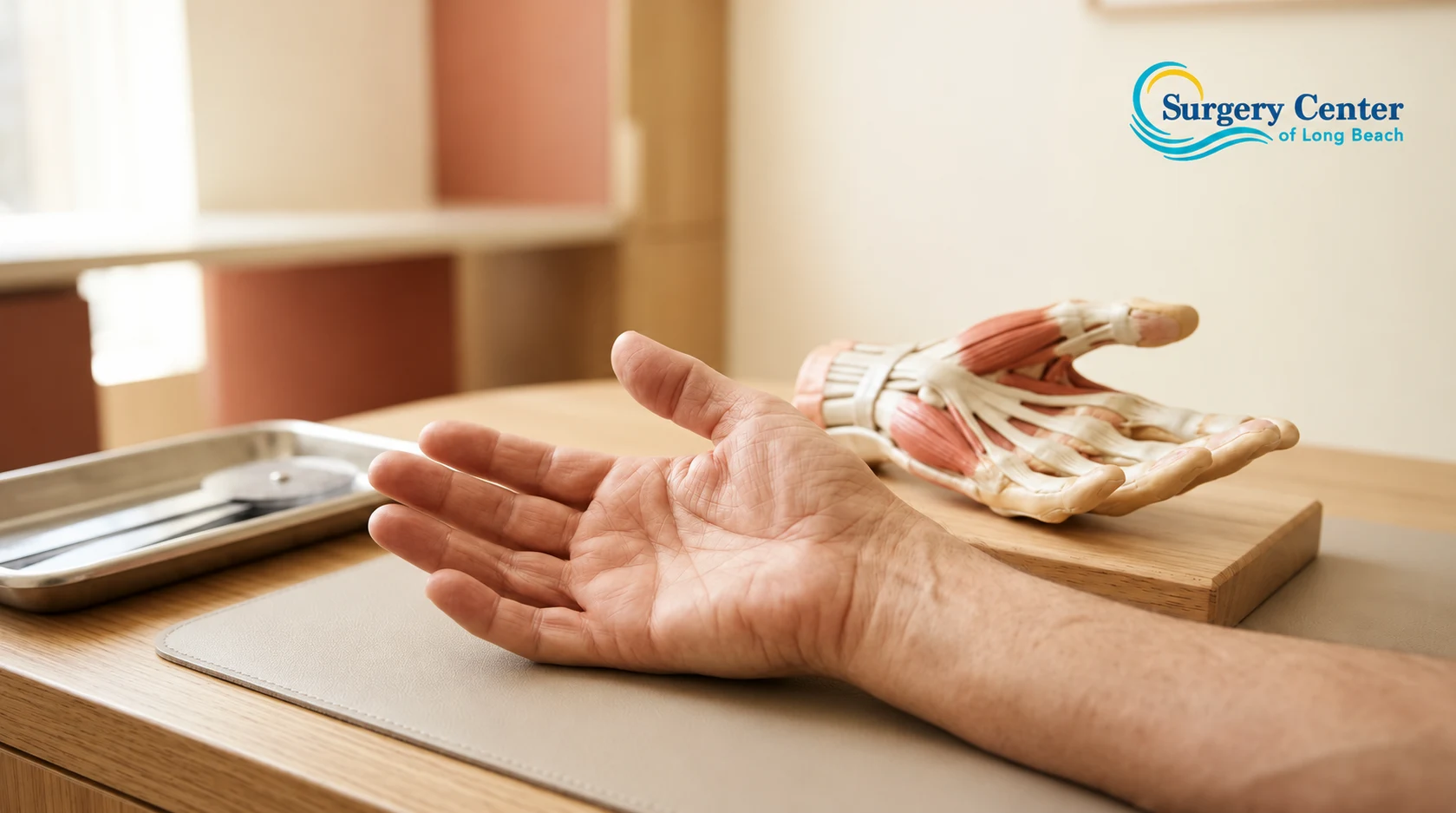
If the bend gets in the way, what are the choices?
The goal is a hand that works better, not necessarily a perfectly straight finger. None of these procedures cures the disease. Ask what is suitable for your cord and joint, which options your surgeon offers and where treatment would take place. [1] [3]
| Option | What you gain | What to weigh |
|---|---|---|
| Needle release (needle aponeurotomy or fasciotomy) | The clinician divides an accessible cord through small skin punctures without removing it. Light hand use generally resumes sooner than after open surgery. | Skin can split, and a nerve or blood vessel can be injured. In a five-year randomized comparison, the bend returned more often after needle release than after open surgery. The study measured lost straightening, not whether someone wanted another procedure. [3] [4] |
| Collagenase injection (Xiaflex), where offered | In the U.S., Xiaflex is approved for adults whose contracture involves a cord the clinician can feel. The drug weakens the cord. Return in about 24 to 72 hours for the clinician to check and, if needed, straighten the finger. Don’t try to break the cord yourself. | Bruising affected about 7 in 10 patients in trials. Skin tears during straightening are common: about 1 in 5 patients had a tear when two cords in one hand were treated at the same visit. A severe skin injury can require surgery. Tendon rupture is rare. [5] |
| Open surgery (limited fasciectomy) | The surgeon removes tight tissue through an incision. This may suit you if keeping the finger straighter for longer matters more than a quicker recovery. | Plan for wound care and time to regain motion. Risks include stiffness, a tender scar, infection and nerve or blood vessel injury. If the overlying skin is involved, especially with a returning contracture, the surgeon may discuss removing affected skin as well and covering the area with a skin graft (dermofasciectomy). [1] [3] |
Blood thinners matter when choosing an injection. Xiaflex is generally avoided in people with a bleeding disorder or those taking blood thinners other than low-dose aspirin. Tell the clinician about all medicines and supplements, including low-dose aspirin. Don’t stop or change a blood thinner or diabetes medicine on your own; get a plan from your treating team and prescriber. [5]
Hand use, recurrence and repeat treatment are different outcomes
In a UK randomized trial of adults with a moderate contracture suitable for either injection or limited fasciectomy, injection patients got back to using the hand sooner. Surgery patients rated their hand health somewhat better on average at one year. Minor complications were more common after injection; the less common moderate or severe complications were more frequent after surgery. Injection patients more often needed further treatment during follow-up. The average hand-health score cannot tell you how much easier a particular task will be. [6] [7]
The joint matters, too. One injection study followed 623 joints initially corrected to within 5 degrees of straight. By five years, recurrence was recorded in 39% of base knuckles (where the finger meets the hand) and 66% of middle joints. Recurrence meant at least 20 degrees of renewed bending with a cord the examiner could feel, or another procedure for a new or worsening bend. These figures describe joints that initially straightened—not everyone who received an injection. They cannot be compared directly with the needle-versus-surgery study, which counted recurrence differently. [8] [4]
Plan for the hand you need at home and at work
Before treatment, confirm your eating, drinking and ride instructions. Ask about typing, driving and heavy gripping separately: being able to use a keyboard is not the same as being able to control a drill. After surgery, get a written plan for the dressing, wound check, hand therapy and any splint. Exercises should have a practical goal: opening the hand and closing it around a handle. After Xiaflex straightening, the U.S. instructions specifically call for a bedtime splint and daily finger exercises; ask the clinician to show you how. [9] [1] [5]
Questions to take to your appointment
Diagnosis and choice - Is a cord limiting my base knuckle, middle joint or both? - Which option is most likely to help me do the task I’m struggling with? - If I choose observation, what change should bring me back?
Before treatment - What eating and drinking instructions apply to the anesthesia I’ll have? - Which visits should I book now, including a straightening visit if I choose injection?
Medicines and health conditions - How do my aspirin, blood thinner or bleeding problems affect whether injection is suitable? - Who will coordinate my medication plan, including diabetes medicines, with my prescriber?
Ride and home support - Will I need someone to drive me home or stay with me? - Which two-handed tasks, such as cooking or caring for a child, should I arrange help with?
Recovery - When should I see a hand therapist, and will I need a splint? - What should I be able to do safely before driving or using tools at work?
Urgent help - When should feeling return, and what changes in color or temperature need emergency assessment? - Which contact in my discharge instructions should I use for urgent concerns at night or on weekends?
When to get urgent help
After hand surgery, needle release or an injection, call 911 immediately if you have trouble breathing; your lips, tongue or throat swell; you have sudden chest pain with shortness of breath; or you cough up blood. If you pass out, someone with you should call 911 immediately. [10] [5] [9]
If a treated finger turns white, pale, blue or cold, call your treating team now, day or night. If you cannot speak with a clinician right away, go to an emergency department now. Use the contact instructions in your discharge paperwork. Also call now for numbness that starts after feeling has returned or lasts longer than your team told you to expect; bleeding that soaks the dressing; worsening pain despite medicine; or spreading redness, pus or fever. [5] [9]
After a collagenase (Xiaflex) injection, also call the treating clinician right away if the treated skin tears or turns dark, you feel faint, or you have trouble bending the finger toward your palm once swelling goes down. Trouble bending, rather than straightening, can signal a tendon injury. If you feel faint, lie down until it passes, then call. Also call right away for new numbness, tingling or increasing pain after the injection. [5]
A newly bent finger after an injury is different. Go to an emergency department now for a red, swollen, painful finger that you hold bent, especially after a puncture. The tissue around a tendon may be infected and needs emergency assessment. A sudden inability to bend a finger after a cut also needs same-day assessment for a tendon injury. [11] [12]
After hours, your physician’s practice number reaches an answering service for nonemergency concerns. Follow your discharge instructions for whom to contact.
Learn More
- American Society for Surgery of the Hand: Dupuytren’s Contracture
- American Academy of Orthopaedic Surgeons: Trigger Finger
- British Society for Surgery of the Hand: Dupuytren’s Disease
- Van Rijssen et al.: Five-Year Results of a Randomized Clinical Trial on Treatment in Dupuytren’s Disease: Percutaneous Needle Fasciotomy versus Limited Fasciectomy
- DailyMed: XIAFLEX (collagenase clostridium histolyticum) prescribing information and Medication Guide
- Dias et al.: Collagenase injection versus limited fasciectomy surgery to treat Dupuytren’s contracture in adult patients: the DISC non-inferiority RCT and economic evaluation
- Dias et al.: Collagenase injection versus limited fasciectomy for Dupuytren contracture
- Peimer et al.: Dupuytren Contracture Recurrence Following Treatment With Collagenase Clostridium histolyticum (CORDLESS Study): 5-Year Data
- MyHealth.Alberta.ca: Fasciectomy for Dupuytren’s Contracture: What to Expect at Home
- American Academy of Allergy, Asthma & Immunology: Anaphylaxis
- American Society for Surgery of the Hand: Hand Infection
- American Academy of Orthopaedic Surgeons: Flexor Tendon Injuries
Sources checked November 26, 2026.