

Published
Bunion surgery usually moves the bones at the base of the big toe back into line. Hammertoe surgery straightens the bent middle joint of a smaller toe. If that smaller toe still bends, the surgeon may be able to change the pull of a tendon. If the joint is stuck, it may need to be reshaped or fused. The reason to consider either operation is pain that makes walking or wearing shoes difficult despite simpler care—not the shape of the toe alone. [1] [2]
If you have both problems, start with the activity you want back. “I want to walk the dog without the top of my second toe rubbing raw” tells the surgeon more than “I want my toes straight.” It also gives you a way to judge whether a change in shoes helps enough, and what you would need an operation to accomplish. [1] [2] [3]
Which joint is causing the trouble?
| What to compare | Bunion | Hammertoe |
|---|---|---|
| Where you may feel it | The inside edge of the foot, where the big toe meets the foot. The bump may hurt against a shoe, or the joint itself may ache when you walk. [1] [3] | The top of a smaller toe where its raised knuckle meets the shoe, or the tip where it presses down. A corn may form at a pressure point. [2] [3] |
| What the surgeon checks | How far the big toe leans toward its neighbor, how well the joint moves, and how the bones line up on an X-ray taken while you stand. [1] [3] | Whether the middle knuckle can be gently straightened. The surgeon also checks whether the toe lifts or is tight at its base. [2] |
| What surgery changes | Usually the position of a bone, sometimes along with the tissues that pull on the toe. Removing the bump alone seldom corrects the alignment. [1] | The pull of a tendon, the shape of the middle knuckle, or both. A fused knuckle is meant to stay straight rather than bend. [2] |
The big-toe joint is sometimes called the MTP joint. It is where the first long bone of the foot meets the toe. The raised middle knuckle of a hammertoe is the PIP joint. A smaller toe also has a joint at its base. That distinction matters if, for example, your main pain is under the ball of your foot rather than on top of the knuckle. Point to both places if both hurt; the proposed repair should make sense for the pain you actually feel. [1] [2] [3]
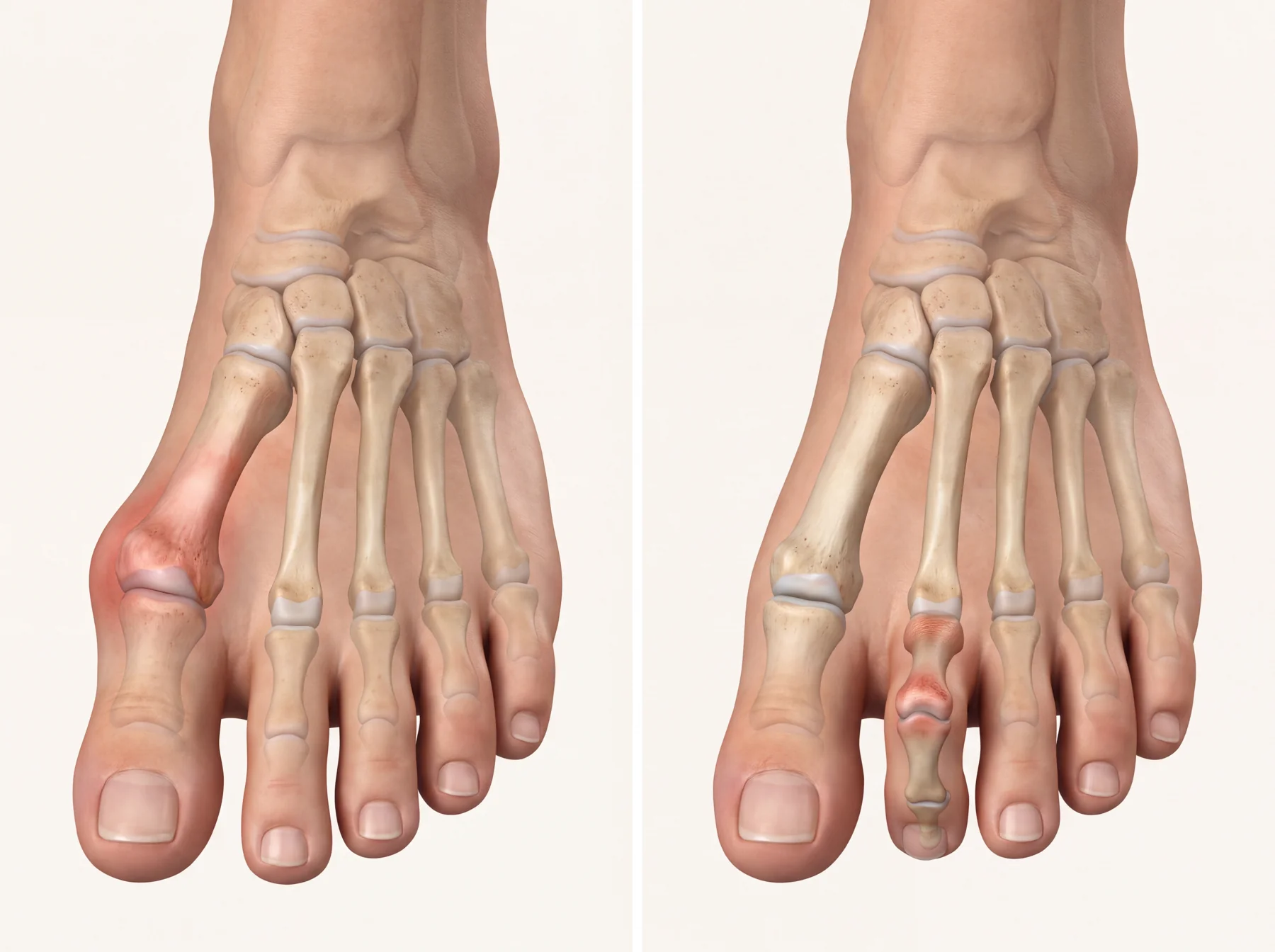
- 1Big-toe joint prominence and toe angling toward its neighbor.
- 2Second-toe middle joint bent in a hammertoe pattern.
What can you try before surgery?
For a bunion, check the width of the shoe where the big-toe joint sits. For a hammertoe, check the height of the shoe above the knuckle. A wide shoe with a low top can solve one problem and leave the other untouched. A softer upper, a shoe stretched over a sore spot, or a cushion that fits without crowding the toe may make walking more comfortable. These changes relieve pressure; they do not permanently put bunion bones back in line. [1] [2] [3]
An open sore is not a shoe-fit experiment. If you have diabetes, numb feet, or poor circulation and notice an open sore, a blister, or a new change in skin color, contact your clinician promptly, even if it does not hurt. Reduced feeling can hide an injury. For people with diabetes, [NIDDK’s foot-care guidance][r4] advises against cutting a corn or using medicated corn pads or liquid removers. They can damage the skin you are trying to protect. [4] [5]
For a painful bunion, a [German specialty-society guideline][r6] recommends usually trying nonsurgical care for about three months before an operation. Its panel describes ongoing symptoms despite that care as the usual reason to consider surgery. Three months is not a deadline to have an operation, a waiting period for a skin wound, or a rule for hammertoe. If your usual shoes are comfortable again and you can do what matters to you, a bump that remains visible is not, by itself, a reason to operate. [1] [2] [6]
For a painful bunion, how does surgery compare with waiting?
A [Finnish randomized trial][r7] followed 209 adults with painful mild-to-moderate bunions. Their average age was 48, 93% were women, and the big-toe angle was no more than 35 degrees. Researchers compared one operation—a V-shaped bone cut called a distal chevron osteotomy—with a shoe insert or a waiting list. The results show both a benefit and a cost. [7]
| Initial treatment assignment | Said their foot had improved at one year | Average sick leave from work during that year |
|---|---|---|
| Bunion surgery | 83% | 53 days |
| Shoe insert | 46% | 0 days |
| Waiting list | 24% | 12 days |
Patients knew which treatment they had and rated their own improvement. Their expectations could have affected those ratings. “Improved” did not mean pain-free, although the surgery group also reported less pain when walking. The 53 days was a group average, not a recommended leave period. The trial did not test severe bunions, other bunion operations, or hammertoe correction. [7]
At two years, walking pain was similar across the original groups. By then, 43 of 69 people assigned a shoe insert and 48 of 69 assigned to wait had undergone surgery. So the follow-up helps answer “What if I wait and decide later?” It does not show that using an insert for two years works as well as having surgery. A 2024 Cochrane review found 25 trials, but 24 compared operations with one another. For surgery versus an insert or waiting, the reviewers had low confidence in the pain estimate and very low confidence in estimates of complications or repeat surgery. [8] [9]
Bunion correction: which joint will still bend?
With an osteotomy, the surgeon cuts a bone, shifts it, and holds it in place while it heals. Screws, a plate, or pins may hold the new position. The surgeon may also loosen tight tissue or tighten loose tissue around the joint. Part of the bump can be trimmed at the same time. The aim is to change where the bones point while keeping the big-toe knuckle able to bend. That is different from promising it will regain full motion. [1]
With a fusion, the aim is for two bone surfaces to heal together. If the big-toe knuckle has severe, painful arthritis, fusing it gives up motion at that joint to relieve pain. Another type of bunion repair fuses a joint farther back, where the long bone behind the big toe meets the midfoot. That does not fuse the big-toe knuckle itself. If the word fusion comes up, ask the surgeon to point to the joint on your X-ray and show you which movement you would lose. [1] [6]
A small incision does not necessarily mean a small change inside the foot. The [American Orthopaedic Foot & Ankle Society’s position statement][r10] describes minimally invasive surgery as an option for “mild to moderately severe hallux valgus (HV) deformity.” Hallux valgus is the medical name for the big toe leaning toward the smaller toes. This approach can still involve cutting a bone and fixing it with screws. When comparing it with open surgery, ask what each approach would change in your foot and whether the walking instructions would differ. [1] [10]
Hammertoe correction: what if the knuckle is flexible? What if it is fixed?
A flexible hammertoe is one the clinician can gently bring straight during the exam. The surgeon may lengthen a tight tendon or move a tendon so that its pull holds the toe in a better position. If the toe also rides up where it joins the foot, the surgeon may need to loosen tissue at that joint. Ask whether the plan addresses just the spot rubbing the shoe or also what is pulling the toe up. [2]
A fixed hammertoe stays bent during the exam. One operation, called resection, removes a small piece of bone so the knuckle can straighten; scar tissue can fill the space. Another operation fuses the middle knuckle. A temporary pin can hold the toe in place with either repair. Seeing a pin, then, does not tell you whether the surgeon expects the knuckle to move after healing. [2]
In a randomized study of 55 patients with 89 rigid smaller toes, fusion produced straighter toes on side-view X-rays than resection. At one year, the researchers found no clear difference in pain or foot function. Some patients also needed tissue released at the base of the toe. This was a small study of stiff toes, not a comparison of tendon procedures for flexible ones. [11]
A separate trial compared small-incision and open surgery in 100 adults with several kinds of smaller-toe deformity. At 18 months, 95 provided follow-up information and 84 had a complete assessment. Both groups reported better function, with no clear difference between them. Wound complications, including infections, were more common after open surgery. Among those assessed by X-ray, bone failed to heal fully in six definite cases in the open group, compared with none in the small-incision group. The open operations generally involved a fusion; the small-incision operations used a bone cut. Most patients also had another foot problem treated. Incision size alone cannot explain the results. [12]
If both toes hurt, do both need surgery?
A big toe that leans against the second toe can crowd it, but making more room does not necessarily straighten a knuckle that is already fixed. Likewise, straightening a smaller toe may not solve pressure from a painful bunion. Ask the surgeon to describe the likely result of treating the bunion alone, the smaller toe alone, or both. In each case, which sore spot should improve? Which might remain? [2] [3]
If both repairs are proposed, ask for one walking plan for the whole foot. You may need to protect a bone cut near the big toe and a pin in the second toe at the same time. Find out which repair limits your first steps and what the surgeon needs to see before you can do more. That information is more useful for planning a ride to work or getting upstairs than the number of procedures on the consent form. [1] [2] [3]
What could go wrong, and what does “coming back” mean?
Either operation can leave pain, stiffness, numbness, infection, or a toe that drifts again. A bone cut or fusion may not heal. After bunion surgery, a screw can irritate the foot or pressure can shift under a neighboring toe. After hammertoe surgery, the smaller toe can feel unstable. Rates vary with the operation and your health. Ask, “For patients like me having this repair, how often does pain persist, and how often is another operation needed?” [1] [2] [3]
An X-ray change is not the same as a painful return of the bunion. In a 14-year follow-up of two bunion bone cuts, researchers counted a bunion as recurrent if the big-toe angle on X-ray was greater than 15 degrees, even without symptoms. Of 73 feet assessed, 55 met that definition, but only one patient had another operation on the same toe. About three-quarters of the original group took part in follow-up. These figures explain why it is worth asking what recurrence means; they are not the odds for every bunion repair. [13]
Before surgery: make the plan fit your day
Tell the surgical and anesthesia teams about diabetes, poor circulation, numbness, any skin wound, smoking, a past blood clot, allergies, and previous problems with anesthesia. Bring a list of what you take, including nonprescription medicines and supplements. Ask for your own written directions about medicines, food, and drink. In particular, ask who will advise you about a blood thinner or diabetes medicine rather than deciding on your own when to stop or restart it. [1] [2] [3] [14]
Plan the trip from the car to your bathroom, not just the ride home. Are there steps without a handrail? Could you get through the bathroom door with a walker? If you may need crutches, ask to practice before surgery. Arrange a driver, and consider who could carry a meal or help with shopping. If you live alone, have trouble balancing, or cannot keep weight off one foot, say so before you choose a date. [1] [14]
Recovery: first steps, shoes, work, and driving
Get the walking instruction in words you can use. “No weight” means keeping weight off the operated foot, even for the few steps to the bathroom. “Heel only” is different from “some weight” or “full weight in the protective shoe.” Some bunion repairs allow early protected steps; others need a period without weight. A boot is not permission to walk normally. Ask the team to show you how to stand and turn, and to write down when your walking limit will be checked again. [1] [14]
Know what to do when feeling returns. A nerve block can numb the foot at first, and pain may increase as it wears off. [Pain guidance specifically for bunion repair][r15] supports using more than one kind of pain relief when appropriate, with opioids used only if other pain medicines are not enough. Ask what is safe for you, what not to combine, and whom to contact if your plan is not working. The guidance is not a prescription for every toe operation. [14] [15]
Know what the first follow-up is for. A clinician may check the incision, stitches, toe position, and any pin. If a wire sticks out, ask how to keep the dressing dry and the wire from catching on socks or bedding. Contact the surgical team if the pin shifts or comes out; do not try to put it back. After bone work, the surgeon may use X-rays to check healing. Ask which joints you may move rather than trying to bend a pinned or fused knuckle. [2] [3] [6] [16]
Treat footwear, work, and driving as separate milestones. Swelling can last for months. Once you are cleared for an ordinary shoe, a wide, deep shoe may fit before a work boot does. If you need a safety shoe, bring it or a photo to follow-up. A desk job where you can raise your foot poses a different challenge from an eight-hour shift on concrete. For driving, discuss which foot works the pedals, whether you can brake hard in an emergency, and whether a boot or medicine could interfere. Being able to walk to the car does not mean you are ready to drive it. [1] [3] [17]
After surgery: when should you get help?
- Call 911 for sudden trouble breathing, chest pain, or coughing up blood. These can be signs of a clot in the lung, even without calf symptoms. [18] [17]
- Call your surgical team immediately if a toe becomes cold, pale, or blue, or you develop worsening numbness, especially under a tight dressing. If you cannot reach the team right away, go to an emergency department. Do not wait for your follow-up visit. [14] [17]
- Get medical assessment the same day for new pain, tenderness, or swelling in one calf. Call your surgical team or another healthcare professional right away and say that you recently had surgery. A leg clot needs prompt assessment. [16] [18]
- Call the surgical team right away for spreading redness, pus or a bad smell from the wound or pin, fever, bleeding that soaks the dressing, an incision that opens, or pain that keeps getting worse despite the plan you were given. [1] [16] [17]
Before you leave, get the contact instructions in writing, including what to do outside office hours. You and anyone helping you should be able to answer three questions: Where can I put weight today? What change means I need help now? What must heal before I can get back into the shoe I need? [1] [2] [14] [17]
Questions to ask your physician
Choose the questions that match the toe, the operation being proposed, and the support you have at home. If someone will help after surgery, bring them to the planning conversation when possible.
Understanding the foot problem
- Which joint and toe are causing my pain? Can you show me what the examination and weight-bearing X-rays reveal?
- What shoe changes, padding, inserts, or other nonsurgical steps are still worth trying, and how would we know whether they help enough?
- If surgery is reasonable, which bone, tendon, or joint would you change? Would any joint be fused, and what movement would remain?
- If I have both a bunion and a hammertoe, do both need treatment now? What are the tradeoffs of one operation versus two?
- What is the chance that pain, stiffness, swelling, a toe deformity, or the need for another operation could persist in my case?
Preparing safely
- If I have diabetes, poor circulation, nerve numbness, a prior wound, or a history of blood clots, what assessment or extra monitoring do I need before surgery?
- Who will review my prescriptions, blood thinners, insulin, other diabetes medicines, GLP-1 medicines, pain medicines, and supplements with the anesthesia team? Where will my written, individualized medicine plan come from?
- Which anesthesia and pain-control options may fit my procedure and health? Who should I tell about past anesthesia reactions or nausea?
- Which costs should I confirm for the surgeon, facility, anesthesia, protective shoe or boot, therapy, and follow-up visits?
Home and recovery
- Will I need someone to drive me home and stay with me? Can that person hear the instructions about the dressing, shoe, medicines, and warning signs?
- Where can I put weight after this particular operation, and what equipment or help will I need for stairs, bathing, meals, work, or caring for another person?
- When and how will you check wound healing, a pin if one is used, swelling, and alignment? What would change the plan for shoes, driving, or return to work?
- Which changes in toe color or temperature, wound appearance, leg swelling, breathing, or pain mean call 911, seek urgent assessment, or contact your office? What is the after-hours number?
Learn More
- American Academy of Orthopaedic Surgeons. Bunion Surgery. OrthoInfo
- American Orthopaedic Foot & Ankle Society. What Is Hammertoe Surgery? FootCareMD
- Royal National Orthopaedic Hospital. A Patient’s Guide to Bunion (Hallux Valgus) and Lesser Toe Deformities. January 2026
- National Institute of Diabetes and Digestive and Kidney Diseases. Diabetes & Foot Problems
- Northamptonshire Healthcare NHS Foundation Trust. Caring for Your Feet if You Have Diabetes or Are at High Risk. September 21, 2026
- Deutsche Assoziation für Fuß- und Sprunggelenk and Deutsche Gesellschaft für Orthopädie und Unfallchirurgie. S2e-Leitlinie Hallux valgus. AWMF 187-051, German full text, version 5.2; sections 5.2, 8.1 and 8.2
- Torkki M, Malmivaara A, Seitsalo S, et al. Surgery vs orthosis vs watchful waiting for hallux valgus: a randomized controlled trial. JAMA. 2001;285:2474–2480
- Torkki M, Malmivaara A, Seitsalo S, et al. Hallux valgus: immediate operation versus 1 year of waiting with or without orthoses. Acta Orthop Scand. 2003;74:209–215
- Dias CGP, Godoy-Santos AL, Ferrari J, Ferretti M, Lenza M. Surgical interventions for treating hallux valgus and bunions. Cochrane Database Syst Rev. 2024;7:CD013726
- American Orthopaedic Foot & Ankle Society. Minimally Invasive Surgery for Hallux Valgus Deformity. Position statement approved November 19, 2024
- Schrier JC, Keijsers NL, Matricali GA, et al. Lesser toe PIP joint resection versus PIP joint fusion: a randomized clinical trial. Foot Ankle Int. 2016;37:569–575
- Weigang B, Garkisch A, Simon A, Mittlmeier T. Correction of lesser toe deformities: minimally invasive versus open surgery—a prospective randomised study. Arch Orthop Trauma Surg. 2025;145:511
- Jeuken RM, Schotanus MGM, Kort NP, et al. Long-term follow-up of a randomized controlled trial comparing scarf to chevron osteotomy in hallux valgus correction. Foot Ankle Int. 2016;37:687–695
- South Tees Hospitals NHS Foundation Trust. Preparing for Foot and Ankle Surgery
- Wust M, Desai N, Joshi GP, et al. Pain management after hallux valgus repair surgery: an updated systematic review and procedure-specific postoperative pain management (PROSPECT) recommendations. Eur J Anaesthesiol. 2026;43:11–18
- NHS Fife. Foot and Ankle Surgery. Sections on dressings, external pins, healing, and blood clots
- WebMD Ignite. Surgery for Hammer Toe: What to Expect at Home. Kaiser Permanente Health Encyclopedia. October 1, 2026
- Centers for Disease Control and Prevention. About Venous Thromboembolism (Blood Clots). March 5, 2025
Sources checked November 21, 2026.