

Published
Fusion, or arthrodesis, joins the bones at a painful joint so it no longer moves. Replacement, or implant arthroplasty, substitutes joint surfaces to preserve some movement. Either can relieve symptoms in selected patients, but the best choice depends on the exact joint, its alignment, the surrounding joints, your health, and what you need to do. An ankle comparison cannot simply be applied to a big toe, hand, knee, or spine.
What changes in the foot and ankle?
At the ankle, fusion stops up-and-down movement where the shinbone meets the talus. Other foot joints may still move, but they do not fully replace that motion. A total ankle replacement uses artificial surfaces to allow some movement at the ankle. Neither procedure necessarily treats pain from a different foot joint. At the base of the big toe, fusion stops movement at that joint during push-off, while some implant operations aim to retain movement. Ask the surgeon to show which joint is being treated and what motion would remain.
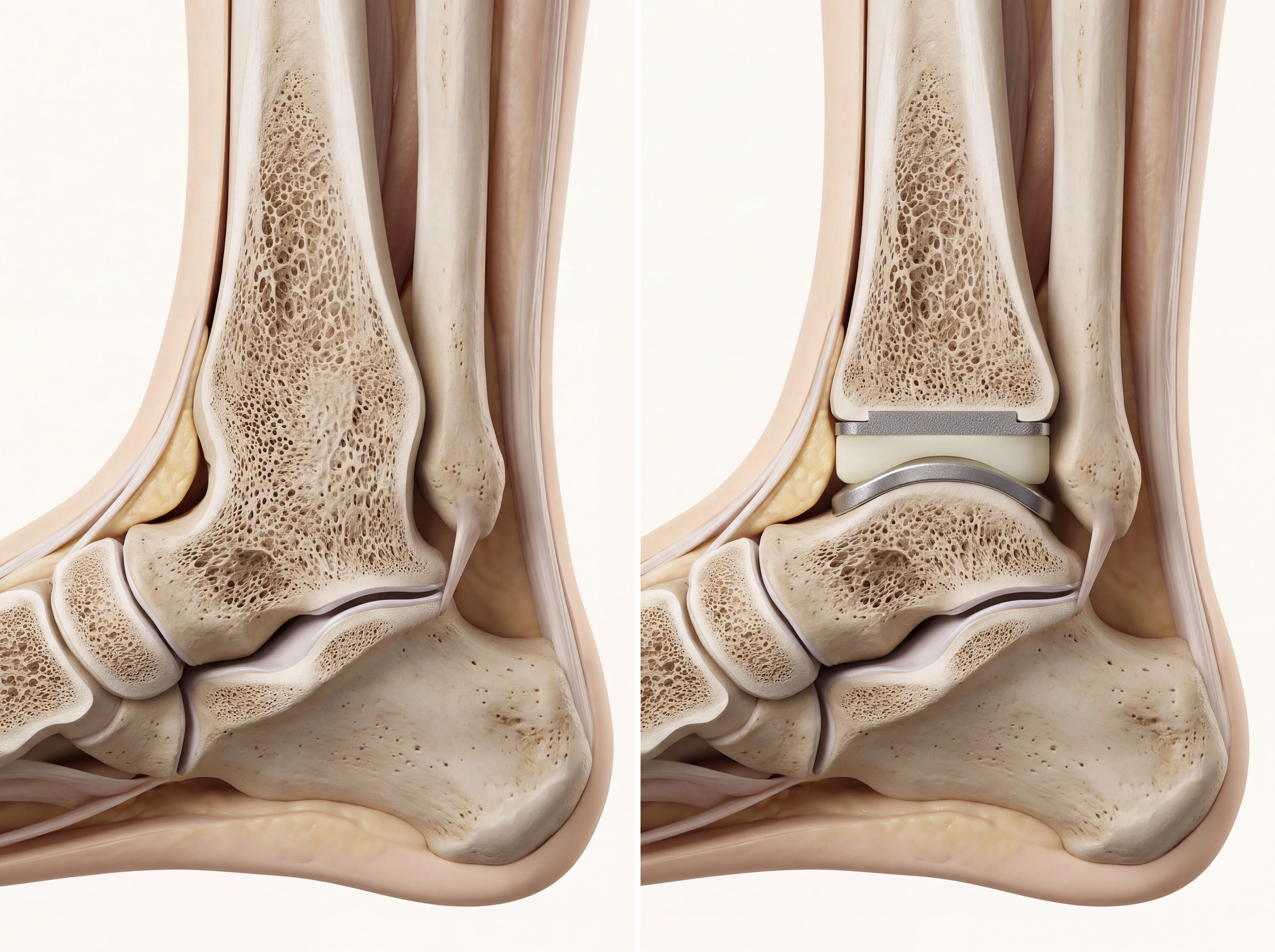
- 1Bone bridge across the fused ankle joint.
- 2Artificial ankle surfaces with a bearing between them.
- 3Subtalar joint below the replaced ankle remains a separate joint.
Which options come before surgery?
The AAOS foot and ankle arthritis guide describes activity changes, bracing, physical therapy, and other nonsurgical measures as options before surgery. For big-toe arthritis, a stiff-soled shoe can reduce painful bending. In selected cases a surgeon may remove a bone spur rather than fuse or replace the joint. Ask whether another treatment could meet your goal and how you will decide when surgery is worth considering.
What does the ankle evidence actually show?
In the TARVA randomized trial, 303 adults aged 50–85 with end-stage ankle osteoarthritis at 17 UK hospitals were considered suitable for both fusion and replacement. At 52 weeks, people in both groups reported better walking and standing. The average result did not establish that one operation was clearly superior overall. A year is also too short to judge how long an implant will last. This study applies most directly to people who could reasonably have either operation; it cannot tell someone with another type of joint disease which to choose.
The kinds of complications differed. In TARVA, wound-healing problems were reported more often after replacement, while symptomatic failure of the bones to unite occurred in some fusion patients. These are group findings, not a prediction of your risk. Ask how your circulation, bone quality, alignment, diabetes, previous surgery, and nearby joints change the choice. An implant needs appropriate support and alignment; a fusion needs bone healing.
Does keeping motion always mean better function?
No single measure of joint motion captures whether you can walk comfortably, climb stairs, or wear shoes needed for work. Severe arthritis may already have removed much useful motion. A replacement may retain movement yet still leave pain or need another operation. A fusion may relieve painful movement but change how you walk or use neighboring joints. Tell your surgeon what activities matter most, and ask what limitation to expect even if the operation goes well.
Big-toe arthritis, called hallux rigidus, is a separate decision. The AAOS guide describes fusion as an established option for severe disease and discusses replacement for selected people. A small randomized trial compared fusion with one older total toe implant in 77 toes. At two years, pain improved in both groups but more after fusion; six of 39 implants were removed for loosening. That result cannot predict every modern implant. If replacement is proposed, ask for the device name and evidence for that device in the joint being treated.
How will recovery differ?
After fusion, fixation holds the bones while they grow together. A healed skin incision does not prove bone union. Follow-up examinations and imaging help the surgeon decide when activity or weight bearing can advance. Therapy may restore strength and movement in neighboring joints; it cannot make the fused joint bend again. After replacement, joint motion exercises and permission to stand or walk may follow different schedules. The procedure, wound, bone quality, and surgeon's protocol determine your instructions.
Ask for a plan covering a boot or cast, mobility aids, stairs, driving, work, medication questions, and follow-up. Do not assume that the timeline for an ankle operation applies to a big toe. Your surgeon, anesthesia team, and therapist should tailor the plan to your operation and home situation.
Questions to ask your surgeon
- Which joint is causing pain, and how much useful motion does it have now?
- Am I a reasonable candidate for both options? If not, why?
- Which activity is each operation likely to help, and what tradeoff would remain?
- If you recommend an implant, what is it and what evidence supports it in this joint?
- How will you check healing or implant function, and what would another operation involve?
- What help, equipment, and follow-up will I need?
See the center's arthrodesis overview. This comparison explains choices to discuss; it does not establish which procedures are offered at the center or which operation is right for you.
Sources
- AAOS OrthoInfo: Arthritis of the Foot and Ankle
- Goldberg et al., TARVA trial, PubMed
- AAOS OrthoInfo: Hallux Rigidus
- Gibson et al., first MTP fusion versus arthroplasty, PubMed
Sources checked November 20, 2026. This article is general education and does not replace advice from your own care team.