

Published
Call 911 now for sudden numbness or weakness of the face, arm or leg; trouble speaking or understanding speech; sudden trouble walking; new loss of bladder or bowel control; chest pain; trouble breathing; rapidly growing neck swelling; or difficulty swallowing so severe you cannot swallow your saliva. Do not drive yourself or wait for a callback. After surgery, use the contacts on your surgeon’s discharge sheet for worsening swallowing or voice problems, tingling that develops gradually without weakness, fever, spreading redness, drainage, or pain that is not controlled by your plan. If you cannot reach the surgical team promptly about a concerning change, seek emergency assessment and have someone else drive you. Before surgery, contact the clinician treating your neck promptly if hand clumsiness, grip or balance is worsening over days or weeks. [1] [2] [3]
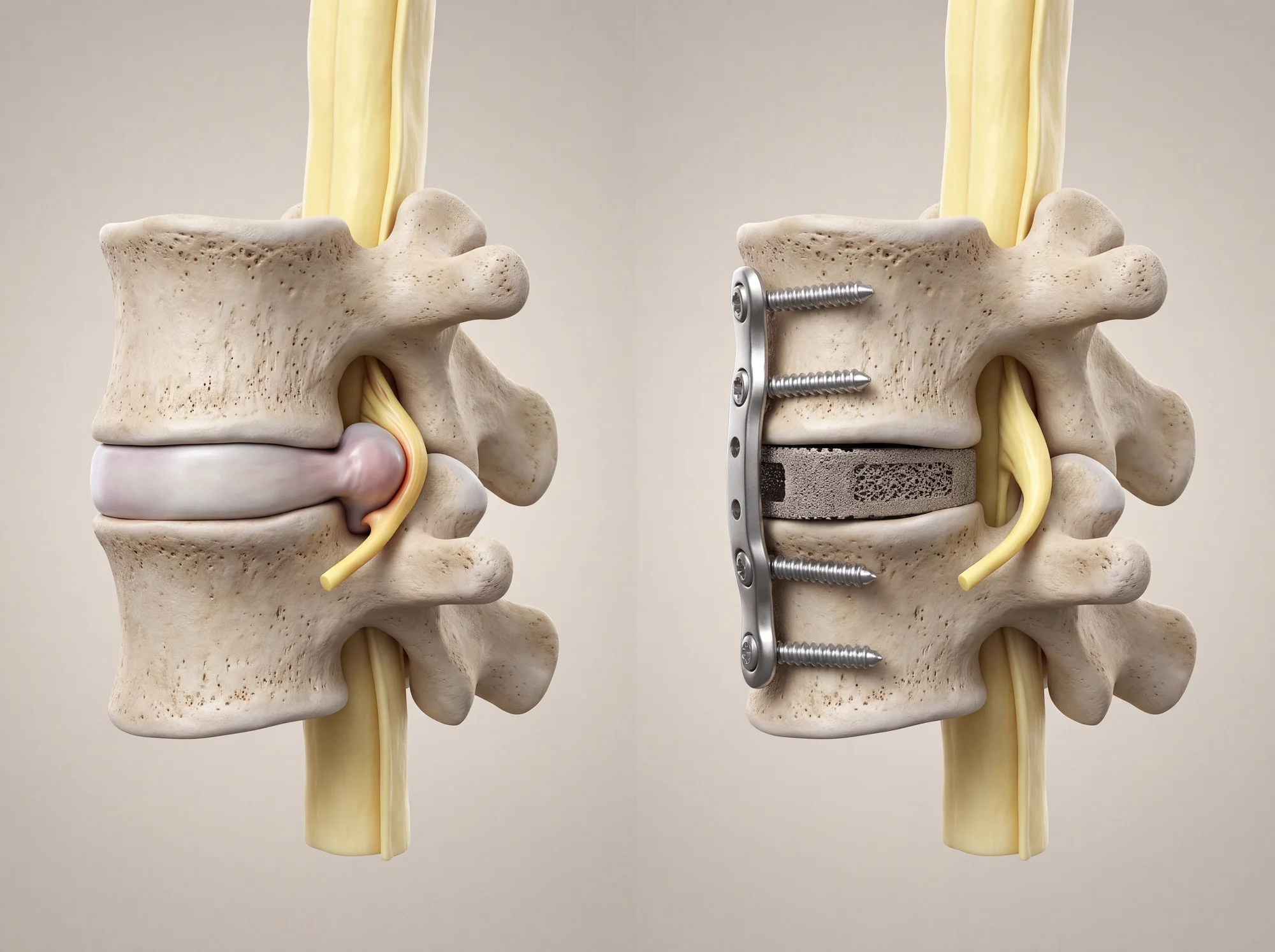
- 1Disc bulge beside the exiting nerve before surgery.
- 2Exiting nerve shown in yellow.
- 3Spacer between the vertebrae after disc removal.
- 4Front plate and screws used in this conceptual fusion model.
A front-of-neck fusion has two possible jobs: make room for a compressed nerve or spinal cord, and hold the treated bones steady while they join. Which job matters most depends on your symptoms, examination and scan. Our anterior cervical fusion guide introduces the procedure. Ask your surgeon to name the exact operation, level and goal proposed for you. [4]
Is the pressure on a nerve or the spinal cord?
A nerve root leaves the spinal cord through a small opening. A herniated disc or extra bone can narrow that opening. This may cause pain running down one arm, tingling in certain fingers or weakness when you lift or grip. This is cervical radiculopathy. The side and level on the scan should make sense alongside your symptoms and examination; a scan finding alone does not decide treatment. [5]
The spinal cord carries signals to the arms and legs. Pressure on it can make buttons harder to fasten, cause you to drop objects or make walking less steady. This is cervical myelopathy when the cord is affected clinically. Tell your clinician about new changes in your hands, balance, walking or bladder control. The decision about surgery can be different from the decision for arm pain alone. [6] [7]
What happens in a common front-of-neck operation?
“Anterior” means the surgeon reaches the spine from the front of the neck. “Cervical” refers to the neck. The term ACF does not specify exactly what will be removed. A common example is anterior cervical discectomy and fusion, or ACDF. Some operations remove part of a vertebral body instead. Check the full name on your consent form. [4]
For ACDF, the anesthesia team usually gives general anesthesia. The surgeon moves the tissues in front of the spine aside, removes the affected disc and any bone or disc material pressing on the nerve or cord, and supports the gap with a graft or spacer. A plate and screws may also be used. The hardware provides support; fusion is the new bone bridge that develops over time. At a single level such as C5–C6, those two bones will no longer move against each other when fusion is complete. Other levels can still move. [1] [8]
How do other choices compare?
| Situation | Choice to discuss | What the evidence can and cannot tell you |
|---|---|---|
| Arm pain, stable strength and no cord symptoms | Activity changes, physical therapy and medicine suited to your health may help. An epidural steroid injection may be discussed for inflammation; it does not remove a spur or disc. | Many pinched neck nerves improve without surgery. Rare but serious neurological injuries have been reported after epidural steroid injections; ask about the risks of a neck injection. [5] [9] |
| One-sided nerve symptoms at one level | A posterior foraminotomy may open the nerve exit from the back, sometimes without fusion. | In the FACET trial, 265 adults with single-level cervical radiculopathy were randomized. Posterior surgery met the trial’s criteria for results no worse than ACDF for arm pain and treatment success at two years. Nine posterior and seven anterior patients had another operation. This was not a trial of cord compression. [10] |
| A suitable disc and stable bones and joints | A surgeon may discuss artificial disc replacement to preserve motion at the treated level. | It is an option for selected people, not a guarantee against pain or future surgery. Ask whether your anatomy and bone health make it suitable. [8] |
| Cord compression affecting function | The surgeon may make room from the front or back, with or without fusion depending on anatomy and stability. | A trial in 163 adults with multilevel myelopathy found no clear average difference in physical function at one year between front and back approaches. Complications differed. The trial does not decide the right route for an individual scan. [11] |
In two Norwegian trials, 180 adults aged 20–65 with at least three months of neck and arm pain were assigned to ACDF or six structured rehabilitation visits. For disc herniation, the surgery group had a 7.4-point average advantage on a 100-point disability scale at one year; the investigators had prespecified 15 points as a clinically important difference. For narrowing caused by wear, the difference was not clear. People with substantial or rapidly progressing weakness were excluded. This comparison is about active rehabilitation, not simply waiting, and it does not settle decisions for spinal cord symptoms. [12]
For moderate or severe myelopathy, a spine guideline recommends surgery. For mild myelopathy, it recommends either surgery or a supervised rehabilitation trial with close follow-up; surgery is recommended if neurological function worsens or fails to improve. If a scan shows cord compression but there are no signs of myelopathy, the approach differs according to whether there is also a pinched nerve. A recommendation to treat the cord does not automatically specify fusion from the front. [7]
How should I prepare?
Bring a list of every medicine and supplement and tell the surgeon and anesthesia team about blood thinners, diabetes, sleep apnea, prior anesthesia problems, smoking or vaping, and any existing hoarseness or trouble swallowing. Ask for one written plan covering fasting, medicines and when to restart them. Do not stop a blood thinner or diabetes medicine on your own. [13]
If you take semaglutide, tirzepatide or another GLP-1 medicine, tell anesthesia the dose, when you last took it, any recent dose increase and whether you have nausea or vomiting. Many patients can continue these medicines, while some need a different eating or anesthesia plan. Follow the instructions your own team gives you. [14]
Our preparation guide asks you to arrange a ride and escort home, plus someone to stay with you for the first 24 hours. Ask your surgeon whether your health, the number of levels or your home situation calls for a hospital setting with an overnight stay. If you use nicotine, ask about stopping: bone healing and fusion can be affected by smoking. Ask whether ibuprofen, naproxen or other anti-inflammatory medicine is appropriate after your operation; your surgeon’s advice depends on the procedure and your health. [13] [15]
What happens during recovery?
A sore throat, hoarse voice or uncomfortable swallowing can occur after a front-of-neck operation. Tell your team if you already have swallowing trouble. Follow the discharge instructions for food, walking, lifting, incision care, a collar if prescribed, and follow-up imaging. Feeling better is not the same as having a solid bone fusion; healing is checked over time. Do not drive while medicine makes you drowsy. [2] [8]
Keep the surgeon’s discharge contacts close by, including the route to use at night, on weekends and holidays. For a nonemergency concern before surgery when your physician’s practice is closed, call that practice’s published number to reach its after-hours answering service. Use the regular office message process for routine matters. Your specific discharge contacts take priority after surgery.
Questions to take to your appointment
Diagnosis and choice
- Can you show me where my scan and examination suggest pressure on a nerve or the cord?
- Which symptom or loss of function are we trying to improve or prevent from worsening?
- What might remain after treatment, and how will we measure whether it helped?
- What would happen if I first tried structured rehabilitation, and when would you recheck me?
- Why is fusion needed instead of another way to make room for the nerve or cord?
Operation and preparation
- What is the exact operation name, side and level, and what graft or hardware do you expect to use?
- How do my bone health, nicotine use or swallowing history change the plan?
- Who will reconcile instructions for fasting, blood thinners, diabetes medicines and GLP-1 medicines?
- Which symptoms before the operation mean I should call you promptly or call 911?
Home, recovery and urgent help
- Should this operation take place in an outpatient setting or a hospital for me?
- What should my companion help with during the first day and afterward?
- What are my limits for lifting, walking and driving, and how will fusion be checked?
- May I take anti-inflammatory medicines after surgery, and when?
- Can we review the warning signs and the exact day and night contacts on my discharge sheet?
This article is for education and does not replace advice from your surgeon and anesthesia team. Follow your own operative and discharge instructions.
Learn More
- American Association of Neurological Surgeons. Cervical Spine
- Norton Healthcare. Anterior cervical decompression and fusion recovery
- Centers for Disease Control and Prevention. Stroke signs and symptoms
- Surgery Center of Long Beach. Anterior Cervical Fusion
- American Academy of Orthopaedic Surgeons. Cervical Radiculopathy
- American Academy of Orthopaedic Surgeons. Cervical Spondylotic Myelopathy
- Fehlings et al. Clinical Practice Guideline for Degenerative Cervical Myelopathy, 2017
- American Academy of Orthopaedic Surgeons. Cervical Radiculopathy: Surgical Treatment Options
- US Food and Drug Administration. Safe Use Initiative: Epidural Steroid Injections
- FACET trial. Posterior Foraminotomy versus ACDF at Two Years
- Ghogawala et al. Ventral versus Dorsal Surgery for Cervical Myelopathy
- Taso et al. Surgery versus Nonsurgical Treatment of Cervical Radiculopathy
- Surgery Center of Long Beach. How to Prepare for Surgery
- American Society of Anesthesiologists. GLP-1 Medicines and Surgery
- American Academy of Orthopaedic Surgeons. Surgery and Smoking
Sources checked November 23, 2026.