

Published
Discuss surgery if your knee keeps giving way, if your work or sport requires sharp turns, or if another injury in the knee may need treatment. An MRI showing a torn anterior cruciate ligament (ACL) does not, by itself, mean you need an operation. If your knee is steady during the activities that matter to you, physical therapy may be a good first choice. If it buckles when you turn or step down, tell your physician what happens. You do not need to wait for a fall to ask for an assessment. [1] [2]
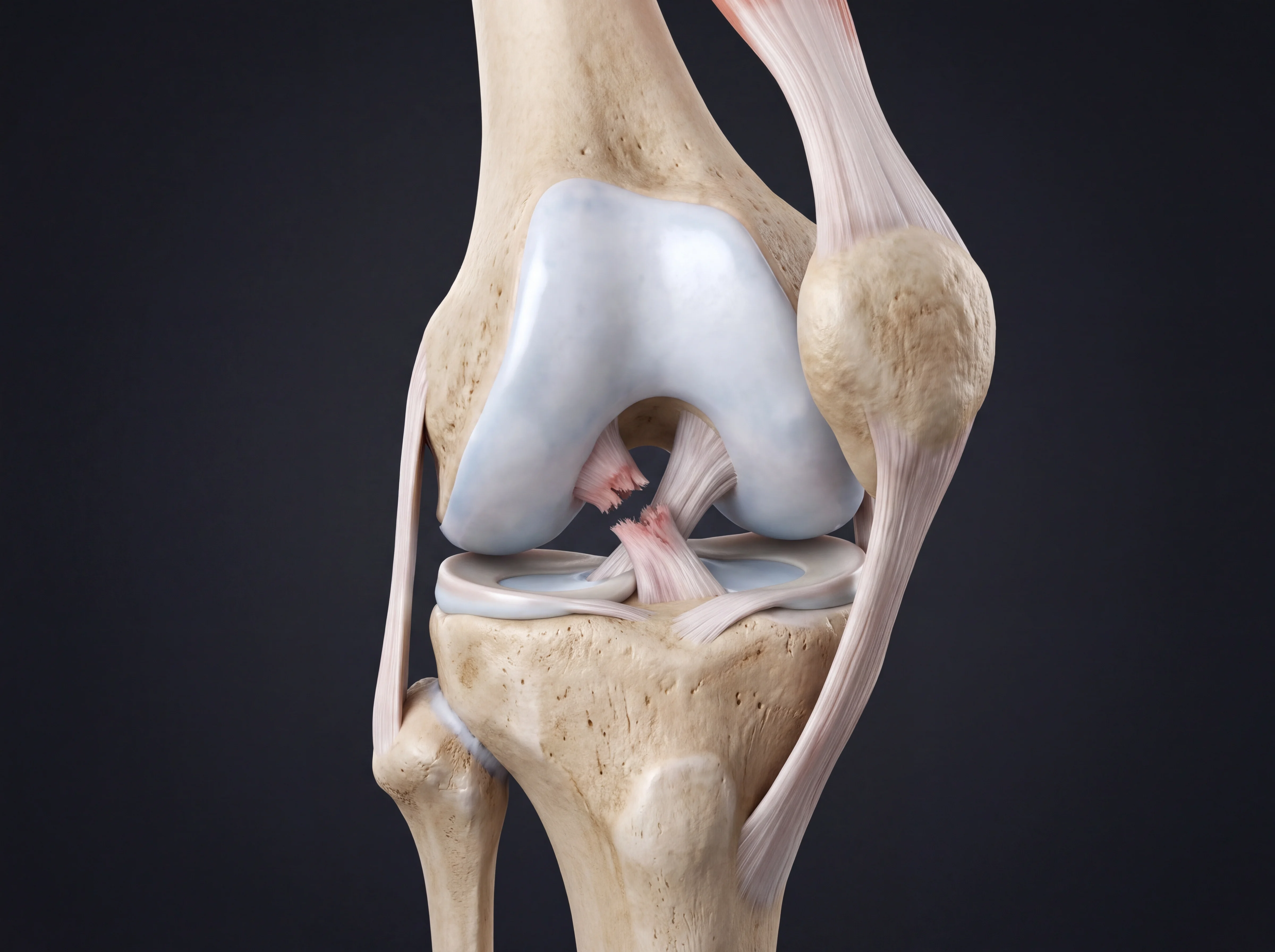
- 1Femur, the thighbone above the knee.
- 2Disrupted ACL fibers inside the knee joint.
- 3Tibia, the shinbone below the joint.
What else was injured?
The ACL connects your thighbone to your shinbone and helps steady the knee when you turn. Your physician will ask how the injury happened, check how far the knee moves and compare its stability with your other knee. An X-ray can show a fracture but not the ACL itself. An MRI can show a torn ACL, damage to a meniscus (a C-shaped cushion between the bones), or injury to the smooth cartilage covering the bone ends. Those findings can change your treatment choices. [2]
After an injury, go to an emergency department now if your knee looks misshapen or your foot becomes numb, cold, pale or blue. Seek same-day care if you cannot put weight on the leg, the knee locks and will not straighten, or the knee becomes hot, red and swollen with a fever. Do not wait for a routine therapy appointment. [3] [4]
What would make rehabilitation a good choice?
Physical therapy helps you regain motion, rebuild strength and practice controlling the knee. Pick a task you want back: descending your front steps, turning with a box at work or changing direction on a tennis court. Agree with your therapist on how to measure progress and when to reassess. Mention tasks you have stopped doing. “It hasn’t buckled since I stopped using the stairs” is different from “I can use the stairs again.” [1] [2]
A recent tear and a knee that remains unstable are different decisions. In one trial of young, active adults with recent tears, average knee symptoms and function were similar 11 years after assignment to early reconstruction or to rehabilitation with the option of surgery later. About half of those assigned to rehabilitation first eventually had reconstruction. [5] Another trial of recent tears found a small average advantage for early surgery at two years; whether patients would notice that difference was uncertain. [6] In contrast, among people with an older injury and ongoing instability, a surgery-first plan produced better average knee scores at 18 months. [7]
Age alone does not decide the question. An older adult who works on ladders may need more stability than someone whose main goal is cycling. Findings from young athletes do not tell an older adult how much surgery will help with walking. If pain and stiffness bother you more than buckling, ask whether arthritis is contributing. For a teen who is still growing, ask how growth plates affect the surgical options. [1] [2]
If surgery makes sense, when and what kind?
If a recent tear of the ACL alone needs surgery, the American Academy of Orthopaedic Surgeons (AAOS) recommends earlier reconstruction because the risk of further meniscus or cartilage injury starts to rise within three months. That is not a deadline for every tear. Ask how swelling, difficulty straightening the knee or another injury affects your timing. [1]
Our ACL procedure page gives a shorter overview of surgery. Reconstruction replaces the torn ligament with tendon tissue called a graft. Repair preserves the original ligament. For tears that need surgery, AAOS strongly recommends reconstruction over repair because a repeat ACL operation is less likely. If repair is proposed, ask why the location of your tear makes it an option. [1]
A graft can come from your own tendon or from a donor. AAOS favors your own tissue, particularly if you are young or active, because the graft is less likely to fail. For people whose bones have finished growing, a kneecap tendon graft may lower failure or infection risk; a hamstring graft may cause less pain when kneeling. With a hamstring graft, some athletes returning to pivoting sports may be offered extra stabilization on the outer side of the knee. It may reduce graft failure in selected patients; long-term outcomes are uncertain. [1]
Preparing for surgery and the first night home
If your procedure is with us, our preparation guide directs you to your surgeon or our nursing staff for questions about blood pressure or diabetes medicines. Bring a list of prescriptions, nonprescription medicines and supplements, including blood thinners. Ask for one written plan coordinated with your prescriber and anesthesia team. If medicine or fasting instructions conflict, call before acting. [8]
Mention semaglutide or tirzepatide whether you take it for diabetes or weight loss. These medicines can slow stomach emptying, which matters during anesthesia. Report recent dose increases, nausea or vomiting. Also flag SGLT2 medicines such as empagliflozin or dapagliflozin, even if prescribed for your heart or kidneys: around surgery they can increase the risk of a dangerous buildup of acids called ketoacidosis. Ask for instructions early; do not stop or restart medicines on your own. [9]
We ask you to arrange for someone to bring you, escort you home and stay with you for the first 24 hours. Tell us beforehand if that is difficult. Have your companion listen to the discharge instructions with you, especially how much weight you can put on the leg and how to move safely if a nerve block leaves it numb. [8] [10]
Recovery and warning signs
A meniscus repair can change how soon you may bend the knee or put weight on it. For work, describe what a shift actually involves. For sport, returning to practice is not the same as playing a full game. Your therapist and surgeon can assess swelling, motion, strength, landing control and confidence; neither a date nor a single test guarantees a safe return. [10] [11]
In a review of athletes younger than 25 who returned to pivoting or jumping sports after reconstruction, about 23 in 100 had another ACL injury in either knee during follow-up. That includes tears in the opposite knee, not just graft tears. It is not an estimate for someone returning to ordinary walking. [12]
After surgery, call your surgical team promptly for spreading redness, drainage, fever, worsening pain, bleeding that soaks the dressing, inability to keep fluids down or numbness lasting longer than expected. Seek emergency care for a cold, pale or blue foot. New calf pain or swelling needs same-day assessment for a possible clot. Call 911 for sudden trouble breathing, chest pain, coughing up blood or fainting. [10] [13]
Questions to bring to your visit
Credentials and treatment choice - What are your orthopedic credentials and your experience treating ACL injuries like mine? - Besides the ACL, what was injured? - What would count as success with therapy for the activity I want back? - What would I gain or risk by waiting? - Which operation and graft would you recommend for me, and why?
Preparation, medicines and support - What anesthesia is planned, and how will I manage pain as it wears off? - Where can I find patient forms, and which records should I bring? - Who will confirm my fasting and medication instructions? - If I have diabetes, how should I monitor and respond to low blood sugar while fasting? - Does my GLP-1 or SGLT2 medicine change my preparation plan? - What should my companion practice with me before we leave?
Recovery and urgent signs - How should I use crutches, manage stairs and care for the dressing? - What must I be able to do before driving, working or playing sport? - Which symptoms need a same-day call, and which mean calling 911? - What number should we use after hours?
This article is for education, not a diagnosis or a personal treatment plan. If you think you are having a medical emergency, call 911.
Learn More
- AAOS: Management of Anterior Cruciate Ligament Injuries
- AAOS OrthoInfo: Anterior Cruciate Ligament (ACL) Injuries
- MedlinePlus Medical Encyclopedia: Knee pain
- Princess Alexandra Hospital NHS Trust: Soft Tissue Injury – Knee
- KANON randomized trial: Treatment for Acute Anterior Cruciate Ligament Tear in Young Active Adults, 11-year follow-up
- Early surgical reconstruction versus rehabilitation with elective delayed reconstruction for patients with anterior cruciate ligament rupture: COMPARE randomised controlled trial
- Rehabilitation versus surgical reconstruction for non-acute anterior cruciate ligament injury (ACL SNNAP): a pragmatic randomised controlled trial
- Surgery Center of Long Beach: How to Prepare for Surgery
- American Diabetes Association: Diabetes Care in the Hospital—Standards of Care in Diabetes—2026
- MedlinePlus Medical Encyclopedia: ACL reconstruction—discharge
- Aspetar clinical practice guideline on rehabilitation after anterior cruciate ligament reconstruction
- Wiggins et al.: Risk of Secondary Injury in Younger Athletes After Anterior Cruciate Ligament Reconstruction: A Systematic Review and Meta-analysis
- Alberta Health Services: ACL Reconstruction Home Care
Sources checked November 22, 2026.